
Making Sense of TikTok: A User-Centric Exploration of Digital Culture, Everyday Use, and Algorithmic Experiences
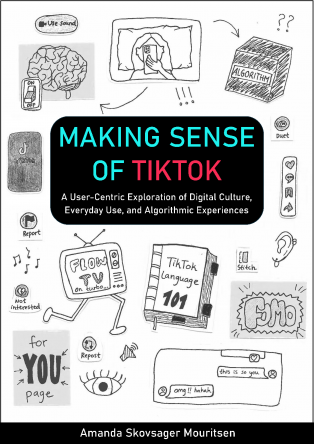
-

This work is licensed under a Creative Commons Attribution-NonCommercial 4.0 International License.
-

Contributors
Keywords
TikTok, Audience studies, Youth, Denmark, Digital Culture, Social Media, Reception research
Abstract
This PhD dissertation explores TikTok from a user-centric perspective by examining how young Danes (aged 15–29) use, experience, and make sense of the platform as part of their everyday media practices. Situated within the tradition of media reception research, the dissertation approaches TikTok primarily as a lived media environment shaped through users’ engagement, interpretations, and experiences. The overarching research question guiding the project is: How is TikTok embedded in young Danes’ everyday lives, and how do they make sense of the platform as part of their media practices? The dissertation addresses this question through three analytical dimensions: (1) the content and digital culture encountered by young Danes on TikTok, (2) young Danes’ everyday practices and motivations for using the platform, and (3) young Danes’ experiences and perceptions of TikTok as a media platform. By integrating these dimensions, the project provides a comprehensive and nuanced account of TikTok as an influential part of contemporary digital media culture.
The dissertation is based on a research design combining mobile data donation and in-depth interviews. Through mobile data donation, 24 young Danish TikTok users donated parts of their TikTok Data Download Packages, enabling the analysis of 1,200 videos they have encountered on the platform. Additionally, in-depth interviews with 24 young Danes explore how users integrate TikTok into daily routines, how they experience and understand the platform and its recommendation algorithm, and how they reflect on their relationship with TikTok.
The dissertation consists of four research articles. The first article contributes methodologically by exploring the potential of mobile data donation for qualitative and small-scale digital media research. It conceptualizes data donation as a collaborative and ethically grounded research practice and demonstrates how digital trace data can be meaningfully integrated into qualitative inquiry. The second article examines TikTok video content in a Danish context by mapping genres and identifying recurring characteristics across the 1,200 sampled videos. Drawing on the concept of templatability, the article introduces the notion of TikTok-ness to describe defining features of the platform’s digital culture, including mundanity, humor, audio-centricity, and the pervasive use of platform features. The third article focuses on users’ everyday experiences of TikTok. Through interview analysis, it shows that TikTok is deeply embedded in daily routines and experienced as a highly immersive, hybrid media platform. Central to this their experience of algorithmic flow, in which users adopt a largely receptive and passive mode of engagement, trusting the algorithm to curate content aligned with their preferences. Additionally, their experiences reflect hybrid forms of agency, where human actions and algorithmic processes interact and mutually shape one another. The fourth article examines the ambivalence that characterizes users’ experiences and perceptions of TikTok. Drawing on concepts of group-level and within-person duality, the analysis demonstrates how TikTok is simultaneously experienced as relaxing and stressful, enriching and addictive, familiar and unsettling. In doing so, it highlights how interactions with TikTok are characterized by ongoing, coexisting tensions and profound ambivalence.
The dissertation contributes empirically, theoretically, and methodologically to the fields of TikTok research, digital media studies, and audience studies. By combining mobile data donation with qualitative interviews, the project offers a comprehensive and multi-layered exploration of TikTok as an influential media platform in the contemporary media landscape. Through its rich empirical foundation, it provides insights into how young users use, experience, perceive, and ultimately make sense of TikTok as part of their everyday lives. Empirically, the dissertation offers one of the first analyses of concrete video content encountered by TikTok users and conceptualizes defining characteristics of the platform’s digital culture through the notion of TikTok-ness. Theoretically, it extends media reception research to algorithmically curated platforms by examining everyday use, algorithmic flow, and user agency. Analytically and conceptually, it illuminates duality in user experiences of TikTok, foregrounding ambivalence as a fundamental condition of contemporary platform use. Methodologically, the project demonstrates the qualitative potential of mobile data donation as an ethically grounded and collaborative approach to studying digital media from the users’ perspectives.
Taken together, the dissertation offers a nuanced understanding of TikTok as a cultural, technological, and lived phenomenon, emphasizing how young users actively make sense of the platform within the conditions of contemporary digital media life.
Chapters
-
Introduction
-
State of the Art
-
Research Objects
-
Theoretical Framework
-
Methodology
-
Findings
-
Discussion
-
Conclusions
-
Article 1: Exploring the Qualitative Potential of Mobile Data Donation
-
Article 2: Decoding TikTok-ness
-
Article 3: The Experience of TikTok
-
Article 4: The Duality of TikTok
References
Abidin, C. (2021a). From “Networked Publics” to “Refracted Publics”: A Companion Framework for Researching “Below the Radar” Studies. Social Media + Society, 7(1), 2056305120984458. https://doi.org/10.1177/2056305120984458
Abidin, C. (2021b). From “Networked Publics” to “Refracted Publics”: A Companion Framework for Researching “Below the Radar” Studies. Social Media + Society, 7(1), 2056305120984458. https://doi.org/10.1177/2056305120984458
Abidin, C. (2021c). Mapping Internet Celebrity on TikTok: Exploring Attention Economies and Vis-ibility Labours. Cultural Science Journal, 12(1), 77–103. https://doi.org/10.5334/csci.140
Abidin, C., & Kaye, B. V. (2021). Audio memes, earworms, and templatability: The “aural” turn of memes on TikTok. In Critical meme reader: Global mutations of the viral image. Institute of Network Cultures. https://networkcultures.org/blog/publication/critical-meme-reader-global-mutations-of-the-viral-image/
Aggarwal, C. (2016). Recommender Systems: Vol. Vol. 1. Springer.
Anderson, K. E. (2020). Getting acquainted with social networks and apps: It is time to talk about TikTok. Library Hi Tech News, 37(4), 7–12. https://doi.org/10.1108/LHTN-01-2020-0001
Armour, T., Molsing, B., Ingolf, M., Marslev, N., & Lidegaard, M. E. (2025). Fortsat vækst til DRTV og TV 2 Play. In Medieudviklingen 2024. DR.
Arnaboldi, V., Conti, M., Passarella, A., & Dunbar, R. I. M. (2017). Online Social Networks and information diffusion: The role of ego networks. Online Social Networks and Media, 1, 44–55. https://doi.org/10.1016/j.osnem.2017.04.001
Bang Ramsbæk, K. (2024). Skal TikTok forbydes i Europe? Det mener danske EU-parlamentarikere ikke. DR. https://politiken.dk/viden/tech/art9274444/TikTok-brugere-str%C3%B8mmer-til-Kongressen-for-at-forsvare-appen
Barnette, J. (2022). Hocus-Pocus: WitchTok Education for Baby Witches. In T. Boffone (Ed.), TikTok Cultures in the United States: Vol. First edition. Routledge.
BBC. (2021). Donald Trump-era ban on Tiktok dropped by Joe Biden. BBC. https://www.bbc.com/news/technology-57413227
Bertel, T. F. (2016). ‘Why would you want to know?’: The reluctant use of location sharing via check-ins on Facebook among Danish youth. Convergence: The International Journal of Research into New Media Technologies, 22(2), 162–176. https://doi.org/10.1177/1354856514543250
Beyens, I., Pouwels, J. L., Van Driel, I. I., Keijsers, L., & Valkenburg, P. M. (2020). The effect of so-cial media on well-being differs from adolescent to adolescent. Scientific Reports, 10(1), 10763. https://doi.org/10.1038/s41598-020-67727-7
Bhandari, A., & Bimo, S. (2022). Why’s Everyone on TikTok Now? The Algorithmized Self and the Future of Self-Making on Social Media. Social Media + Society, 8(1), 205630512210862. https://doi.org/10.1177/20563051221086241
Bikic, A. (2024). Forsker til Svend Brinkmann: Vi kan ikke vente på et uopnåeligt studie. Altinget. https://www.altinget.dk/digital/artikel/psykolog-svend-brinkman-er-unuanceret-i-debatten-om-skaerme-og-boerns-mistrivsel
Boeschoten, L., Ausloos, J., Moeller, J., Araujo, T., & Oberski, D. L. (2020). Digital trace data collection through data donation (No. arXiv:2011.09851). arXiv. http://arxiv.org/abs/2011.09851
Boffone, T. (2021). Renegades: Digital Dance Cultures from Dubsmash to TikTok. Oxford University Press. https://doi.org/10.1093/oso/9780197577677.001.0001
Boffone, T. (2022). TikTok Cultures in the United States (1st ed.). Routledge. https://doi.org/10.4324/9781003280705
Boffone, T., & Jerasa, S. (2021). Toward a (Queer) Reading Community: BookTok, Teen Readers, and the Rise of TikTok Literacies. Talking Points, 33(1), 10–16.
boyd, d. (2010). Social network sites as networked publics: Affordances, dynamics, and implications. In Z. Papacharissi (Ed.), A Networked Self (pp. 47–66). Routledge.
boyd, danah m., & Ellison, N. B. (2007). Social network sites: Definition, history, and scholarship. Journal of Computer-Mediated Communication, 13(1), 210–230. https://doi.org/10.1111/j.1083-6101.2007.00393.x
Breuer, J., Kmetty, Z., Haim, M., & Stier, S. (2022). User-centric approaches for collecting Facebook data in the ‘post-API age’: Experiences from two studies and recommendations for future re-search. Information, Communication & Society, 1–20. https://doi.org/10.1080/1369118X.2022.2097015
Brinberg, M., Vanderbilt, R. R., Solomon, D. H., Brinberg, D., & Ram, N. (2021). Using technology to unobtrusively observe relationship development. Journal of Social and Personal Relationships, 38(12), 3429–3450. https://doi.org/10.1177/02654075211028654
Brown, M.-G., Carah, N., Robards, B., Dobson, A., Rangiah, L., & De Lazzari, C. (2024). No Tar-gets, Just Vibes: Tuned Advertising and the Algorithmic Flow of Social Media. Social Media + Society, 10(1), 20563051241234691. https://doi.org/10.1177/20563051241234691
Bruns, A. (2008). Blogs, Wikipedia, Second Life, and beyond: From production to produsage. NY: Peter Lang.
Bruns, A. (2019). Are Filter Bubbles Real? John Wiley & Sons.
Bruns, A. (2021). Echo chambers? Filter bubbles? The misleading metaphors that obscure the real problem. In M. Pérez-Escolar & J. M. Noguera-Vivo (Eds.), Hate Speech and Polarization in Par-ticipatory Society. Routledge.
Buckingham, D. (2017). Media Theory 101: Agency. Journal of Media Literacy, 64(1 & 2). https://aml.ca/wp-content/uploads/2019/09/jml-agency.pdf
Bucknell Bossen, C., & Kottasz, R. (2020). Uses and gratifications sought by pre-adolescent and ado-lescent TikTok consumers. Young Consumers, 21(4), 463–478. https://doi.org/10.1108/YC-07-2020-1186
Burgess, J. (2006). Hearing Ordinary Voices: Cultural Studies, Vernacular Creativity and Digital Storytelling. Continuum, 20(2), 201–214. https://doi.org/10.1080/10304310600641737
Burgess, J., & Green, J. (2018). YouTube: Online Video and Participatory Culture (Second Edition). Polity.
Carmi, E. (2020). Rhythmedia: A Study of Facebook Immune System. Theory, Culture & Society. https://journals.sagepub.com/doi/10.1177/0263276420917466
Cervi, L. (2021). Tik Tok and generation Z. Theatre, Dance and Performance Training, 12(2), 198–204. https://doi.org/10.1080/19443927.2021.1915617
Cervi, L., & Divon, T. (2023). Playful Activism: Memetic Performances of Palestinian Resistance in TikTok #Challenges. Social Media + Society, 9(1), 20563051231157607. https://doi.org/10.1177/20563051231157607
Cervi, L., & Marín-Lladó, C. (2021). What are political parties doing on TikTok? The Spanish case. Profesional de La Información, 30(4). https://doi.org/10.3145/epi.2021.jul.03
Cervi, L., Tejedor, S., & Blesa, F. G. (2023). TikTok and Political Communication: The Latest Fron-tier of Politainment? A Case Study. Media and Communication, 11(2), 203–217. https://doi.org/10.17645/mac.v11i2.6390
Cheng, Z., & Li, Y. (2026). Political Content Engagement Model: A large-scale analysis of TikTok political video content features and audience engagement. Computers in Human Behavior, 174, 108808. https://doi.org/10.1016/j.chb.2025.108808
Coleman, R. (2018). Theorizing the present: Digital media, pre-emergence and infra-structures of feeling. Cultural Studies, 32(4), 600–622. https://doi.org/10.1080/09502386.2017.1413121
Couldry, N. (2016). Life with the Media Manifold: Between Freedom and Subjection. In L. Kramp, N. Carpentier, A. Hepp, R. Kilborn, R. Kunelius, H. Nieminen, T. Olsson, P. Pruulmann-Vengerfeldt, I. Tomanić Trivundža, & S. Tosoni (Eds.), Politics, Civil Society and Participation: Media and Communications in a Transforming Environment. Lumière.
Cox, C. M. (2018). Programming – Flow in the convergence of digital media platforms and televi-sion. Critical Studies in Television, 13(4), 438–454. https://doi.org/10.1177/1749602018796681
Csikszentmihalyi, M. (1990). Flow: The Psychology of Optimal Experience. Journal of Leisure Research, 24(1). https://doi.org/10.1080/00222216.1992.11969876
Cunningham, S., & Craig, D. (2017). Being ‘really real’ on YouTube: Authenticity, community and brand culture in social media entertainment. Media International Australia, 164(1), 71–81. https://doi.org/10.1177/1329878X17709098
Danmarks Statistik. (2023). Digitalisering. Danmarks Statistik. https://www.dst.dk/da/Statistik/temaer/digitalisering#socmedier
De Leyn, T., De Wolf, R., Vanden Abeele, M., & De Marez, L. (2022). In-between child’s play and teenage pop culture: Tweens, TikTok & privacy. Journal of Youth Studies, 25(8), 1108–1125. https://doi.org/10.1080/13676261.2021.1939286
Digitaliseringsministeriet. (2025). Danmark går forrest – politisk aftale sætter en ny standard for digital beskyt-telse af børn og unge. https://www.digmin.dk/digitalisering/nyheder/nyhedsarkiv/2025/nov/ny-politisk-af-tale?fbclid=IwY2xjawOFaapleHRuA2FlbQIxMABicmlkETB1bTBJaXFsT0JUVVd6d3dtc3J0YwZhcHBfaWQQMjIyMDM5MTc4ODIwMDg5MghjYWxsc2l0ZQEyAAEe8RAEbzz849tUR8rG-y3grT3RkLKBppwFOA6wzB20sdOsdZZj9ryD4Fiqq5M_aem_v5XwW1GGQy2g0_XJ7ZYT3w
Drotner, K. (1999). Dangerous Media? Panic Discourses and Dilemmas of Modernity. Paedagogica Historica, 35(3), 593–619. https://doi.org/10.1080/0030923990350303
Dubois, E., & Blank, G. (2018). The echo chamber is overstated: The moderating effect of political interest and diverse media. Information, Communication & Society, 21(5), 729–745. https://doi.org/10.1080/1369118X.2018.1428656
Edwards, S., & Wang, V. (2018). There are two sides to every story: Young people’s perspectives of relationship issues on social media and adult responses. Journal of Youth Studies, 21(6), 717–732. https://doi.org/10.1080/13676261.2017.1418083
Ellis, C. (2007). Telling Secrets, Revealing Lives: Relational Ethics in Research With Intimate Oth-ers. Qualitative Inquiry, 13(1), 3–29. https://doi.org/10.1177/1077800406294947
Escoda, A. P., & Pulido, P. C. (2018). Smartphone y redes sociales para el desarrollo de competen-cias mediáticas y digitales en niños y adolescentes: Musical.ly. Aula Abierta, 47(3), 281–290. https://doi.org/10.17811/rifie.47.3.2018.281-290
Esposito, E. (2017). Artificial Communication? The Production of Contingency by Algorithms. Zeitschrift Für Soziologie, 46(4), 249–265. https://doi.org/10.1515/zfsoz-2017-1014
Faltesek, D., Graalum, E., Breving, B., Knudsen, E., Lucas, J., Young, S., & Varas Zambrano, F. E. (2023). TikTok as Television. Social Media + Society, 9(3), 20563051231194576. https://doi.org/10.1177/20563051231194576
Felaco, C. (2025). Making Sense of Algorithm: Exploring TikTok Users’ Awareness of Content Rec-ommendation and Moderation Algorithms. International Journal of Communication, 19(0), Article 0.
Fink, R. D., & Weyer, J. (2014). Interaction of human actors and non-human agents. A sociological simulation model of hybrid systems. Science, Technology & Innovation Studies, 10(1).
Firth, E., & Marinelli, A. (2025). Datacasting: TikTok’s Algorithmic Flow as Televisual Experience. Media and Communication, 13, 9392. https://doi.org/10.17645/mac.9392
Gerbaudo, P. (2024). TikTok and the algorithmic transformation of social media publics: From so-cial networks to social interest clusters. New Media & Society, 14614448241304106. https://doi.org/10.1177/14614448241304106
Gibbs, M., Meese, J., Arnold, M., Nansen, B., & Carter, M. (2015). #Funeral and Instagram: Death, social media, and platform vernacular. Information, Communication & Society, 18(3), 255–268. https://doi.org/10.1080/1369118X.2014.987152
González, M. C. (2000). The Four Seasons of Ethnography: A creation-centered ontology for ethnog-raphy. International Journal of Intercultural Relations, 24(5), 623–650. https://doi.org/10.1016/S0147-1767(00)00020-1
Gray, A. (2002). Research Practice for Cultural Studies. SAGE. https://doi.org/10.4135/9780857024596
Green, K., & Skinbjerg-Holm, M. (2023). TikTok tordner frem (In Medieudviklingen 2022). DR (Dan-ish Broadcasting Corporation). https://www.dr.dk/om-dr/fakta-om-dr/medieforskning/medieudviklingen/2022
Guzman, A. L. (2018). Human-machine communication. Rethinking communication, technology, and ourselves. Peter Lang.
Haddon, L. (2016). The Domistication of Complex Media Repertoires. In K. Sandvik, A. M. Tho-rhauge, & B. Valtysson (Eds.), The Media and the Mundane: Communication Across Media in Every-day Life. Nordicom.
Hall, S. (1973). Encoding and decoding in television discourse. CCCS Stencilled Occasional Paper, Media Series 7, Centre for Contemporary Cultural Studies, University of Birmingham. Abridged ver-sion in Hall, S. et al. 1980.
Hall, S. (1980). Culture, Media, Language: Working Papers in Cultural Studies, 1972-1979. Routledge.
Hanson, F. A. (2009). Beyond the skin bag: On the moral responsibility of extended agencies. Ethics and Information Technology, 11(1), 91–99. https://doi.org/10.1007/s10676-009-9184-z
Hautea, S., Parks, P., Takahashi, B., & Zeng, J. (2021). Showing They Care (Or Don’t): Affective Publics and Ambivalent Climate Activism on TikTok. Social Media + Society, 7(2), 20563051211012344. https://doi.org/10.1177/20563051211012344
Helles, R. (2016). Theorising Individual Media Use: Mobile Media in Everyday Life. In K. Sandvik, A. M. Thorhauge, & B. Valtysson (Eds.), The Media and the Mundane: Communication Across Me-dia in Everyday Life.
Hepp, A. (2020). Deep mediatization. Routledge.
Hepp, A. (2022). Agency, social relations, and order: Media sociology’s shift into the digital. Communi-cations, 47(3), 470–493. https://doi.org/10.1515/commun-2020-0079
Herring, S. (2008). Questioning the Generational Divide: Technological Exoticism and Adult Con-structions of Online Youth Identity. In D. Buckingham (Ed.), Youth, Identity, and Digital Media. MIT Press.
Honeré, D. R., & Lund, R. S. W. (2025). Regeringen vil lade skoler forbyde smartphones. TV2. https://nyheder.tv2.dk/politik/2025-09-03-regeringen-vil-lade-skoler-forbyde-smartphones
Honigman, B. (2022, April 29). TikTok isn’t a social media platform, according to TikTok. Fast Company. https://www.fastcompany.com/90746981/tiktok-social-video
Issar, S. (2024). The Social Construction of Algorithms in Everyday Life: Examining TikTok Users’ Understanding of the Platform’s Algorithm. International Journal of Human–Computer Interaction, 40(18), 5384–5398. https://doi.org/10.1080/10447318.2023.2233138
Jenkins, H. (2009). What happened before YouTube. In J. Burgess & J. Green (Eds.), YouTube: Online Video and Participatory Culture (First edition). Polity Press.
Jenkins, H. (2006a). Convergence Culture: Where Old and New Media Collide. New York University Press.
Jenkins, H. (2006b). Fans, Bloggers, and Gamers: Exploring Participatory Culture. New York University Press.
Jensen, J. L., & Sørensen, A. S. (2014). Online Social Networks from a User Perspective: A Quantita-tive-Qualitative Framework. In G. Patriarche, H. Bilandzic, J. L. Jensen, & J. Jurišić (Eds.), Audience Research Methodologies: Between Innovation and Consolidation (0 ed.). Routledge. https://doi.org/10.4324/9780203523155
Jensen, K. B. (1991). Reception Analysis: Mass Communication as the Social Production of Meaning. In K. B. Jensen & N. W. Jankowski (Eds.), A Handbook of Qualitative Methodologies for Mass Com-munication Research. Routledge.
Johansen, S. L. (2023). Du skylder vores børn en mere nuanceret debat om skærme, Tesfaye. Altinget. https://www.altinget.dk/artikel/du-skylder-vores-boern-en-mere-nuanceret-debat-om-skaerme-tesfaye
Johansen, S. L. (2024a). Et forbud mod sociale medier for børn under 18 risikerer at gøre mere skade end gavn. Jyllands-Posten. https://jyllands-posten.dk/debat/kronik/ECE17742486/et-forbud-mod-sociale-medier-for-boern-under-18-risikerer-at-goere-mere-skade-end-gavn/
Johansen, S. L. (2024b). ‘I just want to show that I am living a normal life’. Young People with Physi-cal Disabilities on Social Media. Nordisk Tidsskrift for Ungdomsforskning, 5(2), 1–14. https://doi.org/10.18261/ntu.5.2.4
Johansen, S. L. (2025). Hvor blev nuancerne af i diskussionen om børns brug af skærme? Politiken. https://politiken.dk/kultur/medier/art10318467/Hvor-blev-nuancerne-af-i-diskussionen-om-b%C3%B8rns-brug-af-sk%C3%A6rme
Johansen, S. L., Rabøl Hansen, H., & Kofoed, J. (2021). Eksperter: Hen over 2020 er kritikken af børn og unges skærmforbrug forstummet. Det skal vi udnytte efter genåbningen. Politiken. https://politiken.dk/debat/kroniken/art8097546/Hen-over-2020%E2%80%8B-er-kritikken-af-b%C3%B8rn-og-unges-sk%C3%A6rmforbrug-forstummet.-Det-skal-vi-udnytte-efter-gen%C3%A5bningen?fbclid=IwAR0-IJBWnGqQpYmeqtSq8MYgda_h3vdAb_KnpMdn9L1ARV9it21Yr-F0DBE
Jung, J., Yoon, S.-H., Kengesbay, D., & Lee, S. K. (2025). Qualitative Comparison between TikTok and YouTube. International JOURNAL OF CONTENTS, 21(1), 23–36. https://doi.org/10.5392/IJoC.2025.21.1.023
Karizat, N., Delmonaco, D., Eslami, M., & Andalibi, N. (2021). Algorithmic Folk Theories and Identity: How TikTok Users Co-Produce Knowledge of Identity and Engage in Algorithmic Resistance. Proceedings of the ACM on Human-Computer Interaction, 5(CSCW2), 1–44. https://doi.org/10.1145/3476046
Kaye, D. B. V., Chen, X., & Zeng, J. (2021). The co-evolution of two Chinese mobile short video apps: Parallel platformization of Douyin and TikTok. Mobile Media & Communication, 9(2), 229–253. https://doi.org/10.1177/2050157920952120
Kaye, D. B. V., Zeng, J., & Wikström, P. (2022a). TikTok: Creativity and Culture in Short Video. Polity Press.
Kaye, D. B. V., Zeng, J., & Wikström, P. (2022b). TikTok: Creativity and Culture in Short Video | Wiley. Polity; Digital Media and Society Series. https://www.wiley.com/en-gb/TikTok%3A+Creativity+and+Culture+in+Short+Video-p-9781509548927
Keles, B., Grealish, A., & Leamy, M. (2024). The beauty and the beast of social media: An interpreta-tive phenomenological analysis of the impact of adolescents’ social media experiences on their mental health during the Covid-19 pandemic. Current Psychology, 43(1), 96–112. https://doi.org/10.1007/s12144-023-04271-3
Kendall, T. (2021). From Binge-Watching to Binge-Scrolling: TikTok and the Rhythms of #Lock-downLife. Film Quarterly, 75(1), 41–46. https://doi.org/10.1525/fq.2021.75.1.41
Kennedy, H., & Hill, R. L. (2017). The Feeling of Numbers: Emotions in Everyday Engagements with Data and Their Visualisation. Sage Journals. https://doi.org/10.1177/0038038516674675
Kennedy, M. (2020). ‘If the rise of the TikTok dance and e-girl aesthetic has taught us anything, it’s that teenage girls rule the internet right now’: TikTok celebrity, girls and the Coronavirus cri-sis. European Journal of Cultural Studies, 23(6), 1069–1076. https://doi.org/10.1177/1367549420945341
Kim, S. M. (2023). White House: No more TikTok gov’t deviced within 30 days. AP. https://apnews.com/article/technology-politics-united-states-government-ap-top-news-business-95491774cf8f0fe3e2b9634658a22e56
Kircher, M. M. (2025). Is ‘Going Viral’ Dead? New York Times. https://www.nytimes.com/2025/10/09/style/end-of-viral-internet-tiktok-instagram.html
Klug, D., Qin, Y., Evans, M., & Kaufman, G. (2021). Trick and Please. A Mixed-Method Study On User Assumptions About the TikTok Algorithm. 13th ACM Web Science Conference 2021, 84–92. https://doi.org/10.1145/3447535.3462512
Kulturministeriet. (2021). Internetbrug og sociale medier 2021 (Mediernes Udvikling i Danmark). Kultur-ministeriet.
Kurzrock, E. (2019). Intensified Play: Cinematic study of TikTok mobile app. University of Southern California. https://www.academia.edu/40213511/Intensified_Play_Cinematic_study_of_TikTok_mobile_app
Lange, R. (2023). Tiktok deler danske brugertal for første gang. MediaWatch. https://mediawatch.dk/Medienyt/Web/article16543685.ece
Langlais, M. R., Thaler, A., & West, E. (2024). TikTok Too Much? A Qualitative Investigation of Adolescent TikTok Use, Motivation, and Consequences. Youth & Society, 57(4), 593–614. https://doi.org/10.1177/0044118X241282347
Larsen, M. C., & Johansen, S. L. (2024). Social Media Across Everyday Contexts: Digital Childhood and Youth in the Nordics. Samfundslitteratur.
Larsen, M. C., & Ryberg, T. (2011). Youth and Online Social Networking: From Local Experiences to Public Discourse. In E. Dunkels, G.-M. Frånberg, & C. Hällgren (Eds.), Youth Culture and Net Culture: Online Social Practices. Information Science Reference.
Latour, B. (1991). Technology is society made durable. In J. Law (Ed.), A sociology of monsters. Essays on power, technology and domination. Routledge.
Leaver, T., Highfield, T., & Abidin, C. (2020). Instagram: Visual Social Media Cultures | Wiley. Wiley.Com. https://www.wiley.com/en-us/Instagram%3A+Visual+Social+Media+Cultures-p-9781509534395
Lee, A. Y., Mieczkowski, H., Ellison, N. B., & Hancock, J. T. (2022). The Algorithmic Crystal: Con-ceptualizing the Self through Algorithmic Personalization on TikTok. Proceedings of the ACM on Human-Computer Interaction, 6(CSCW2), 1–22. https://doi.org/10.1145/3555601
Li, Y., Guan, M., Hammond, P., & Berrey, L. E. (2021). Communicating COVID-19 information on TikTok: A content analysis of TikTok videos from official accounts featured in the COVID-19 information hub. Health Education Research, 36(3), 261–271. https://doi.org/10.1093/her/cyab010
Lin, J., Swart, J., & Zeng, G. (2023). Theorising TikTok cultures: Neuro-images in the era of short videos. Media, Culture & Society, 45(8), 1550–1567. https://doi.org/10.1177/01634437231202167
Ling, R. (2012). Taken for Grantedness: The Embedding of Mobile Communication into Society. MIT Press.
Literat, I. (2021). “Teachers Act Like We’re Robots”: TikTok as a Window Into Youth Experiences of Online Learning During COVID-19. AERA Open, 7, 2332858421995537. https://doi.org/10.1177/2332858421995537
Literat, I., & Kligler-Vilenchik, N. (2021). How Popular Culture Prompts Youth Collective Political Expression and Cross-Cutting Political Talk on Social Media: A Cross-Platform Analysis. So-cial Media + Society, 7(2), 20563051211008821. https://doi.org/10.1177/20563051211008821
Livingstone, S. (2013). The Participation Paradigm in Audience Research. The Communication Review, 16(1–2), 21–30. https://doi.org/10.1080/10714421.2013.757174
Livingstone, S. (2018). Audiences in an Age of Datafication: Critical Questions for Media Research. Television & New Media. https://doi.org/10.1177/1527476418811118
Lotz, A. D., Johnson, C., & Gray, J. (2025). Rethinking watching: A viewer-centred approach to un-derstanding the changing audience experience. International Journal of Cultural Studies, 13678779251370389. https://doi.org/10.1177/13678779251370389
Lüders, M. (2024). Experience machines for well-being? Understanding how social media entertain-ment matters for teens. Media, Culture & Society, 47(1), 154–170. https://doi.org/10.1177/01634437241276122
Lull, J. (1980). The Social Uses of Television. Human Communication Research, 6(3).
Marengo, D., Angelo Fabris, M., Longobardi, C., & Settanni, M. (2022). Smartphone and social me-dia use contributed to individual tendencies towards social media addiction in Italian adoles-cents during the COVID-19 pandemic. Addictive Behaviors, 126, 107204. https://doi.org/10.1016/j.addbeh.2021.107204
Markham, A. N. (2006). Ethic as Method, Method as Ethic. A Case for Reflexivity in Qualitative ICT Research. Journal of Information Ethics, 15(2), 37–55.
Martens, M., Balling, G., & Higgason, K. A. (2022). #BookTokMadeMeReadIt: Young adult read-ing communities across an international, sociotechnical landscape. Information and Learning Sci-ences, 123(11/12), 705–722. https://doi.org/10.1108/ILS-07-2022-0086
Martin, R. (2019). TikTok, The Internet’s Hottest Meme Breeding Ground, Turns 1. Npr. https://www.npr.org/2019/08/05/748163919/tiktok-the-internets-hottest-meme-breeding-ground-turns-1
Martinez, R. J., Brammer, S. E., & Punyanunt-Carter, N. M. (2023). ‘I Can Spend Forever on It Without Getting Bored’: Analyzing What College Students Like and Dislike About TikTok. Media Watch, 15(1), 113–130. https://doi.org/10.1177/09760911231211835
Mathieu, D. (2015). The Continued Relevance of Reception Analysis in the Age of Social Media. Tripodos, 36, 13–34. https://doi.org/10.51698/tripodos.2015.36.13-34
Miltsov, A. (2022). Researching TikTok: Themes, Methods, and Future Directions. In A. Quan-Haase & L. Sloan, The SAGE Handbook of Social Media Research Methods (pp. 664–676). SAGE Publications Ltd. https://doi.org/10.4135/9781529782943.n46
Molsing, B. M., Hansen, E., Kaasgaard Christiansen, M., & Lidegaard, M. E. (2024). Status 2023: Facebook i frit fald. Medieudviklingen 2023. https://www.dr.dk/static/documents/2024/01/24/medieudviklingen2023_3d87bbd1.pdf
Morley, D. (1980). The “Nationwide” Audience. British Film Institute.
Morley, D. (1986). Family Television: Cultural Power and Domestic Leisure. Comedia Pub. Group.
Morley, D. (1992). Television, Audiences and Cultural Studies (0 ed.). Routledge. https://doi.org/10.4324/9780203398357
Napoli, P. (2003). Audience Economics: Media Institutions and the Audience Marketplace. Columbia Univer-sity Press.
Napoli, P. (2011). Audience Evolution: New Technologies and the Transformation of Media Audiences. Colum-bia University Press.
Napoli, P. M. (2011). Audience Evolution: New Technologies and the Transformation of Media Audiences (p. 272 Pages). Columbia University Press.
Nielsen. (2023, March 31). Medieråd opfordrer børn og unge til at slette TikTok eller ændre deres indstillinger markant. DR. https://www.dr.dk/nyheder/medieraad-opfordrer-boern-og-unge-til-slette-tiktok-eller-aendre-deres-indstillinger-markant
Ohme, J. (2019). When digital natives enter the electorate: Political social media use among first-time voters and its effects on campaign participation. Journal of Information Technology & Politics, 16(2), 119–136. https://doi.org/10.1080/19331681.2019.1613279
Ohme, J., Araujo, T., Boeschoten, L., Freelon, D., Ram, N., Reeves, B. B., & Robinson, T. N. (2023). Digital Trace Data Collection for Social Media Effects Research: APIs, Data Dona-tion, and (Screen) Tracking. Communication Methods and Measures, 18(2), 124–141. https://doi.org/10.1080/19312458.2023.2181319
Ohme, J., Araujo, T., de Vreese, C. H., & Piotrowski, J. T. (2021). Mobile data donations: Assessing self-report accuracy and sample biases with the iOS Screen Time function. Mobile Media & Communication, 9(2), 293–313. https://doi.org/10.1177/2050157920959106
Omar, B., & Dequan, W. (2020). Watch, Share or Create: The Influence of Personality Traits and User Motivation on TikTok Mobile Video Usage. International Journal of Interactive Mobile Tech-nologies (iJIM), 14(04), 121. https://doi.org/10.3991/ijim.v14i04.12429
Omar, M. (2025). The story of the Coldplay couple unfolded like a soap opera. But was the pile-on that followed a proportionate response? The Guardian. https://www.theguardian.com/commentisfree/2025/jul/22/the-story-of-the-coldplay-couple-unfolded-like-a-soap-opera-but-was-the-pile-on-that-followed-a-proportional-response-ntwnfb
O’Reilly, M. (2020). Social media and adolescent mental health: The good, the bad and the ugly. Journal of Mental Health, 29(2), 200–206. https://doi.org/10.1080/09638237.2020.1714007
Oswald, K., & Packer, J. (2013). Flow and Mobile Media: Broadcast Fixity to Digital Fluidity. In J. Packer & S. B. Crofts Wiley (Eds.), Communication Matters: Materialist Approaches to Media, Mobil-ity and Networks. Routledge.
Owens, E. (2024). Teens on TikTok: Understanding Young People’s Digital Agency as Practice. In-ternational Research in Children’s Literature, 17(2), 174–188. https://doi.org/10.3366/ircl.2024.0562
Owens, E. (2025). ‘It speaks to me in brain rot’: Theorising ‘brain rot’ as a genre of participation among teenagers. New Media & Society, 14614448251351527. https://doi.org/10.1177/14614448251351527
Papacharissi, Z. (2014). Affective Publics: Sentiment, Technology, and Politics. Oxford University Press.
Pariser, E. (2011). The Filter Bubble: What the Internet Is Hiding from You. Penguin Books.
Peters, C., Schrøder, K. C., Lehaff, J., & Vulpius, J. (2022). News as They Know It: Young Adults’ Information Repertoires in the Digital Media Landscape. Digital Journalism, 10(1), 62–86. https://doi.org/10.1080/21670811.2021.1885986
Petrovic, S. (2023). From karaoke to lip-syncing: Performance communities and TikTok use in Ja-pan. Media International Australia, 186(1), 11–28. https://doi.org/10.1177/1329878X221106565
Picone, I., Kleut, J., Pavlíčková, T., Romic, B., Møller Hartley, J., & De Ridder, S. (2019). Small acts of engagement: Reconnecting productive audience practices with everyday agency. New Media & Society, 21(9), 2010–2028. https://doi.org/10.1177/1461444819837569
Pink, S., Horst, H. A., Postill, J., Hjorth, L., Lewis, T., & Tacchi, J. (Eds.). (2016). Digital ethnography: Principles and practice. SAGE.
Porter, J. (2024). TikTok ban: All the news on attempts to ban the video platform. The Verge. https://www.theverge.com/23651507/tiktok-ban-us-news
Qin, Y., Omar, B., & Musetti, A. (2022). The addiction behavior of short-form video app TikTok: The information quality and system quality perspective. Frontiers in Psychology, 13. https://doi.org/10.3389/fpsyg.2022.932805
Radway, J. (1984). Reading the Romance: Women, Patriarchy, and Popular Culture. University of North Car-olina Press.
Reuters. (2025). TikTok users top 200 million in Europe, firm says. Reuters. https://www.reuters.com/business/media-telecom/tiktok-users-top-200-million-europe-firm-says-2025-09-05/
Richter, S. af: L. (2023, November 27). Forsker afblæser advarslerne om skærmtid: Det er et tåbeligt begreb. Det handler om, hvad der foregår på skærmen. Information. https://www.information.dk/indland/2023/11/forsker-afblaeser-advarslerne-skaermtid-taabeligt-begreb-handler-foregaar-paa-skaermen
Ritzau. (2021). TikTok laver ændring: Webshops kan sælge direkte til brugerne. Berlingske.dk. https://www.berlingske.dk/content/item/1608193
Ritzau. (2023). Før høring: TikTok-brugere strømmer til Kongressen for at forsvare appen. Politiken. https://politiken.dk/viden/tech/art9274444/TikTok-brugere-str%C3%B8mmer-til-Kongressen-for-at-forsvare-appen
Ritzau. (2025a). Det Hvide Hus opretter TikTok-profil. MediaWatch. https://mediawatch.dk/Medienyt/Web/article18452556.ece
Ritzau. (2025b). Donald Trump: Vi har fundet en køber af TikTok. MediaWatch. https://mediawatch.dk/Medienyt/Web/article18321443.ece
Ritzau. (2025c). Regeringen vil forbyde mobiltelefoner på skoler. DR. https://www.dr.dk/nyheder/politik/regeringen-vil-forbyde-mobiltelefoner-paa-skoler
Ritzau. (2025d). TikTok får milliardbøde for ikke at beskytte data. MediaWatch. https://mediawatch.dk/Medienyt/politik/article18146206.ece
Rochford, E., & Palmer, Z. D. (2022). Trans TikTok: Sharing Information and Forming Communi-ty. In T. Boffone (Ed.), TikTok Cultures in the United States: Vol. First edition. Routledge.
Rodriguez, A., & Zhao, X. (2025). Pushing against the panic: Considering the positives of TikTok and children. International Journal of Cultural Studies, 28(5), 1028–1038. https://doi.org/10.1177/13678779241276011
Roncallo-Dow, S., & Arango-Forero, G. (2017). Introducing Three Dimensions of Audience Frag-mentation. Signo y Pensamiento, 36(70), 74–90. https://doi.org/10.11144/Javeriana.syp36-70.idaf
Rosen, J. (2006). The People Formerly Known as the Audience. PressThink: Ghost of Democracy in the Media Machine. http://archive.pressthink.org/2006/06/27/ppl_frmr.html
Sainato, M. (2025). US and China reach ‘final deal’ on TikTok sale, treasury secretary says. The Guardian. https://www.theguardian.com/technology/2025/oct/26/us-china-tiktok-deal-scott-bessent
Sales, B. D., & Folkman, S. (2000). Ethics in research with human participants. American Psychological Association.
Sandvik, K., Thorhauge, A. M., & Valtysson, B. (2016). Introduction: The Media and the Mundane: Communication Across Media in Everyday Life. In K. Sandvik, A. M. Thorhauge, & B. Valtysson (Eds.), The Media and the Mundane: Communication Across Media in Everyday Life.
Savic, M. (2021). From Musical.ly to TikTok: Social Construction of 2020’s Most Downloaded Short-Video App.
Schellewald, A. (2021). Communicative Forms on TikTok: Perspectives From Digital Ethnography.
Schellewald, A. (2022). Theorizing “Stories About Algorithms” as a Mechanism in the Formation and Maintenance of Algorithmic Imaginaries. Social Media + Society, 8(1), 205630512210770. https://doi.org/10.1177/20563051221077025
Schellewald, A. (2023). Understanding the popularity and affordances of TikTok through user experi-ences. Media, Culture & Society, 45(8), 1568–1582. https://doi.org/10.1177/01634437221144562
Schellewald, A. (2024). Discussing the Role of TikTok Sharing Practices in Everyday Social Life.
Schrøder, K. C. (1988). The pleasure of Dynasty. In P. Drummond & R. Paterson (Eds.), Television and its Audience. British Film Institute.
Schrøder, K. C. (2019). Audience Reception Research in a Post-broadcasting Digital Age. Television & New Media, 20(2), 155–169. https://doi.org/10.1177/1527476418811114
Schrøder, K., Drotner, K., Kline, S., & Murray, C. (2003). Researching Audiences (First edition). Arnold.
Schwartz, J., & Scheutz, S. (2021). TikTok er blevet voksen. In Medieudviklingen 2020. DR.
Shutsko, A. (2020). User-Generated Short Video Content in Social Media. A Case Study of TikTok. In G. Meiselwitz (Ed.), Social Computing and Social Media. Participation, User Experience, Consumer Experience, and Applications of Social Computing (pp. 108–125). Springer International Publishing. https://doi.org/10.1007/978-3-030-49576-3_8
Siles, I. (2023). Living with Algorithms: Agency and User Culture in Costa Rica. The MIT Press.
Siles, I., & Valerio-Alfaro, L. (2025). From Feed to Flow: Watching Television on TikTok. Television & New Media, 15274764251334576. https://doi.org/10.1177/15274764251334576
Siles, I., Valerio-Alfaro, L., & Meléndez-Moran, A. (2022). Learning to like TikTok . . . and not: Al-gorithm awareness as process. New Media & Society, 146144482211389. https://doi.org/10.1177/14614448221138973
Silverstone, R. (1999). Why Study the Media. SAGE.
Silverstone, R., Hirsch, E., & Morley, D. (2021). Information and Communication Technologies and the Moral Economy of the Household. In E. Hirsch & R. Silverstone (Eds.), Consuming Technol-ogies. Routledge.
Şimşek, B., Abidin, C., & Brown, M. L. (2018). Musical.ly and Microcelebrity Among Girls. In C. Abidin & M. L. Brown (Eds.), Microcelebrity Around the Globe: Approaches to Cultures of Internet Fame (pp. 47–56). Emerald Group Publishing Ltd. https://doi.org/10.1108/978-1-78756-749-820181004
Slyngborg, T. (2024). Børns Vilkår bad TikTok gribe ind over for videoer med store sår og guides til, hvordan man skærer i sig selv: Nu tager de sig til hovedet. DR. https://www.dr.dk/nyheder/indland/boerns-vilkaar-bad-tiktok-gribe-ind-over-videoer-med-store-saar-og-guides-til
Solgaard, A. (2024). Meget farligt TikTok-trend: Advarer nu alle forældre. TV2 ØJ. https://www.tv2ostjylland.dk/odder/advarer-nu-alle-foraeldre
Southerton, C. (2021). Lip-Syncing and Saving Lives: Healthcare Workers on TikTok. 15, 3248–3268.
Staksrud, E. (2024). Children and the internet—Ten research insights. In M. C. Larsen & S. L. Johan-sen, Social Media Across Everyday Contexts: Digital Childhood and Youth in the Nordics (First edition). Samfundslitteratur.
Steele, R. G., Hall, J. A., & Christofferson, J. L. (2020). Conceptualizing Digital Stress in Adolescents and Young Adults: Toward the Development of an Empirically Based Model. Clinical Child and Family Psychology Review, 23(1), 15–26. https://doi.org/10.1007/s10567-019-00300-5
Stokel-Walker, C. (2021). TikTok Boom: China’s Dynamite App and the Superpower Race for Social Media (1st ed.). Canbury Press.
Styrelsen for Samfundssikkerhed. (2023, March 1). CFCS’ anbefaling vedrørende TikTok. Styrelsen for Samfundssikkerhed. https://www.cfcs.dk/da/nyheder/2023/cfcs-anbefaling-tiktok/
Sullivan, J. L. (2013). Media Audiences: Effects, Users, Institutions, and Power. SAGE.
Tafradzhiyski, N. (2025). TikTok Revenue and Usage Statistics (2025). Business of Apps. https://www.businessofapps.com/data/tik-tok-statistics/
The Sunday Times. (2020). TikTok: Everything you need to know. https://www.thetimes.co.uk/article/tiktok-everything-you-need-to-know-692pnxdb2
Thorson, K., Cotter, K., Medeiros, M., & Pak, C. (2021). Algorithmic inference, political interest, and exposure to news and politics on Facebook. Information, Communication & Society, 24(2), 183–200. https://doi.org/10.1080/1369118X.2019.1642934
TikTok. (2024). Introduction 1: About TikTok LIVE. TikTok. https://www.tiktok.com/live/creators/en-UK/article/tiktok-live-intro-ugc-eduaction_en-GB?name=undefined
TikTok Creator Academy. (2025). Creator Rewards Program. TikTok Creator Academy. https://www.tiktok.com/creator-academy/en/article/creator-rewards-program
TikTok Cultures Research Network. (N.d.a). Bibliography. TikTok Cultures Research Network. https://tiktokcultures.com/bibliography/
TikTok Cultures Research Network. (N.d.b). Publications. TikTok Cultures Research Network. https://tiktokcultures.com/publications/
TikTok Newsroom. (2020). How TikTok recommends videos #ForYou. TikTok Newsroom. https://newsroom.tiktok.com/en-us/how-tiktok-recommends-videos-for-you
TikTok Newsroom. (2022). Inspiring creativity with our new editing tools. TikTok Newsroom. https://newsroom.tiktok.com/en-us/editing-tools
TikTok Newsroom. (n.d.). About. TikTok Newsroom. https://www.tiktok.com/about?lang=en
TikTok Support. (n.d.). TikTok Stories. TikTok Support. https://support.tiktok.com/en/using-tiktok/creating-videos/tiktok-stories
Tracy, S. J. (2010). Qualitative Quality: Eight “Big-Tent” Criteria for Excellent Qualitative Re-search. Qualitative Inquiry, 16(10), 837–851. https://doi.org/10.1177/1077800410383121
Tracy, S. J. (2020). Qualitative Research Methods: Collecting evidence, crafting analysis, communicating impact (2nd Edition). Wiley.
Trillò, T. (2024). “PoV: You are reading an academic article.” The memetic performance of affilia-tion in TikTok’s platform vernacular. New Media & Society, 14614448241290234. https://doi.org/10.1177/14614448241290234
Uricchio, W. (2004). Television’s Next Generation: Technology/Interface Culture/Flow. In L. Spigel & J. Olsson (Eds.), Television After TV: Essays on a Medium in Transition. Duke University Press.
Uricchio, W. (2009). The Future of a Medium Once Known as Television. In Pelle Snikkars and Patrick Vonderau, ed., The YouTube Reader (pp. 24–39). Wallflower Press. https://www.academia.edu/10952701/_The_Future_of_a_Medium_Once_Known_as_Televi-si-on_in_Pelle_Snikkars_and_Patrick_Vonderau_ed_The_You_Tube_Reader_London_Wallflower_Press_2009_24_39
Valkenburg, P. M., Beyens, I., Pouwels, J. L., van Driel, I. I., & Keijsers, L. (2022). Social Media Browsing and Adolescent Well-Being: Challenging the “Passive Social Media Use Hypothe-sis.” Journal of Computer-Mediated Communication, 27(1). https://doi.org/10.1093/jcmc/zmab015
Valkenburg, P. M., Meier, A., & Beyens, I. (2022). Social media use and its impact on adolescent mental health: An umbrella review of the evidence. Current Opinion in Psychology, 44, 58–68. https://doi.org/10.1016/j.copsyc.2021.08.017
van der Wal, A., Valkenburg, P. M., & van Driel, I. I. (2024). In Their Own Words: How Adoles-cents Use Social Media and How It Affects Them. Social Media + Society, 10(2), 20563051241248591. https://doi.org/10.1177/20563051241248591
Van Driel, I. I., Giachanou, A., Pouwels, J. L., Boeschoten, L., Beyens, I., & Valkenburg, P. M. (2022). Promises and Pitfalls of Social Media Data Donations. Communication Methods and Measures, 16(4), 266–282. https://doi.org/10.1080/19312458.2022.2109608
Vázquez-Herrero, J., Negreira-Rey, M.-C., & López-García, X. (2022). Let’s dance the news! How the news media are adapting to the logic of TikTok. Journalism, 23(8), 1717–1735. https://doi.org/10.1177/1464884920969092
Vázquez-Herrero, J., Negreira-Rey, M.-C., & Rodríguez-Vázquez, A.-I. (2021). Intersections be-tween TikTok and TV: Channels and Programmes Thinking Outside the Box. Journalism and Media, 2(1), Article 1. https://doi.org/10.3390/journalmedia2010001
Verbeij, T., Beyens, I., Trilling, D., & Valkenburg, P. M. (2024). Happiness and Sadness in Adoles-cents’ Instagram Direct Messaging: A Neural Topic Modeling Approach. Social Media + Socie-ty, 10(1), 20563051241229655. https://doi.org/10.1177/20563051241229655
Villebro, M., Shklovski, I., Rossi, L., & Bjørstorp, A. (2018). Comfortably Numb: Danish Teens’ Atti-tudes, Towards Social Media Platforms. Proceedings of the 9th International Conference on Social Me-dia and Society, 187–196. https://doi.org/10.1145/3217804.3217911
Vizcaíno-Verdú, A., & Abidin, C. (2023). TeachTok: Teachers of TikTok, micro-celebrification, and fun learning communities. Teaching and Teacher Education, 123, 103978. https://doi.org/10.1016/j.tate.2022.103978
Waisbord, S. (2014). Introduction: Reappraising media sociology. In S. Waisbord (Ed.), Media sociolo-gy: A reappraisal. Polity.
Webber, T. (2023). TikTok CEO Shou Zi Chew: 3 thing to know. AP. https://apnews.com/article/tiktok-ban-shou-zi-chew-testify-7927b1915db270aac67ca6f4ca31d6f3
Wedel, L., Ohme, J., & Araujo, T. (2024). Augmenting Data Download Packages – Integrating Data Donations, Video Metadata, and the Multimodal Nature of Audio-visual Content. Methods, Data, Analyses, 1–32. https://doi.org/10.12758/mda.2024.08
Weimann, G., & Masri, N. (2023). Research Note: Spreading Hate on TikTok. Studies in Conflict & Terrorism, 46(5), 752–765. https://doi.org/10.1080/1057610X.2020.1780027
Weinstein, E. (2018). The social media see-saw: Positive and negative influences on adolescents’ affec-tive well-being. New Media & Society, 20(10), 3597–3623. https://doi.org/10.1177/1461444818755634
Williams, R. (1975). Television: Technology and Cultural Form. Schocken Books.
Ytre-Arne, B. (2023). Media Use in Digital Everyday Life. Emerald Publishing.
Zannettou, S., Nemes-Nemeth, O., Ayalon, O., Goetzen, A., Gummadi, K. P., Redmiles, E. M., & Roesner, F. (2024). Analyzing User Engagement with TikTok’s Short Format Video Rec-ommendations using Data Donations. Proceedings of the 2024 CHI Conference on Human Factors in Computing Systems, 1–16. https://doi.org/10.1145/3613904.3642433
Zannettou, S., Nemeth, O.-N., Ayalon, O., Goetzen, A., Gummadi, K. P., Redmiles, E. M., & Roesner, F. (2023). Leveraging Rights of Data Subjects for Social Media Analysis: Studying TikTok via Data Donations (No. arXiv:2301.04945). arXiv. http://arxiv.org/abs/2301.04945
Zeng, J., & and Abidin, C. (2021). ‘#OkBoomer, time to meet the Zoomers’: Studying the memefica-tion of intergenerational politics on TikTok. Information, Communication & Society, 24(16), 2459–2481. https://doi.org/10.1080/1369118X.2021.1961007
Zulli, D., & Zulli, D. J. (2022). Extending the Internet meme: Conceptualizing technological mimesis and imitation publics on the TikTok platform. New Media & Society, 24(8), 1872–1890. https://doi.org/10.1177/1461444820983603
Author Biography
PhD, Department of Media Studies and Journalism, Aarhus University
How to Cite
Data Availability Statement
Research data are not available.