
Childhoods in Projects: Children’s Lives in Stigmatised Neighbourhoods
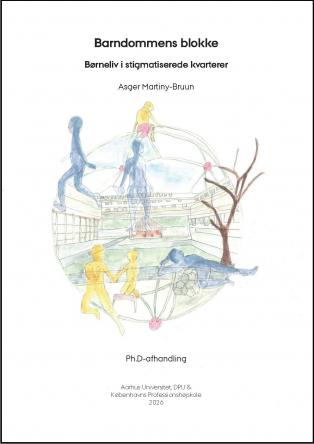
-

This work is licensed under a Creative Commons Attribution-NonCommercial 4.0 International License.
-

Contributors
Keywords
Children's everyday lives, Childhood studies, Territorial stigma, Place attachment, Neighbourhood studies, Community studies, Local communities, Urban marginalisation, Care, Parenting, Racialisation, public spaces, Community-based social work, architectural anthropology
Abstract
The thesis examines how children aged 4–11 and their parents living in territorially stigmatised public housing estates create attachments to — and distance themselves from — local places, communities, and institutions, and how these everyday practices shape social connections and social differentiation in the local community. The thesis consists of a synopsis and three articles.
The research project is based on eight months’ fieldwork in two public housing estates — Taastrupgaard and Gadehavegaard — in the Copenhagen’s West End. The two neighbourhoods have been on the official list of ‘hard ghetto’ areas and are subject to policy measures that promote social mixing and the integration of the neighbourhoods into their surroundings. These interventions explicitly aim to ensure that the children who grow up here gain a better understanding of ‘Danish norms and values’. Nevertheless, there is limited knowledge of how growing up in these neighbourhoods affects children, and of how children’s lives shape neighbourhood relations, parenting, and the neighbourhoods’ symbolic status.
Through participant observation of everyday life, leisure activities, and housing‑based social work in public space, as well as participant‑oriented and place‑sensitive interviews with children, parents, and professionals, the thesis offers a nuanced account of the relationship between children’s and parents’ agency and the structural conditions that enable attachment to — or distancing from — local places and communities in stigmatised neighbourhoods. The thesis shows that attachment to place can be understood as a relational practice rooted in the topography of neighbourhoods and, at the same time, encompassing an ambivalent and mutual moral obligation to a social community.
The thesis draws on childhood studies’ understanding of children’s agency and connects this with anthropological and phenomenological theories of how meaning arises in a dialectical interplay between social practices and the topography of place (understood as the material, historical, symbolic, and political aspects that constitute a place). It also engages with theories and scholarship on territorial stigmatisation, neighbourliness, and the social figurations between established groups and outsiders.
In the thesis synopsis, I describe how shifting housing‑ and integration‑policy rationales, architectural ideals, and socio‑economic dynamics since the 1960s have shaped places and the conditions for children’s lives and neighbourliness in public housing estates. The analyses show how the concentration of socially vulnerable residents and the territorial stigmatisation of residential areas are the result of structural processes, state governance logics, and housing‑policy priorities that include a racialisation of social problems and a pedagogisation of public space, which shape norms for parenting and children’s public lives in residential areas through legislation and housing‑based social work.
The first article, ‘Growing up in the “Ghetto”’, describes differences in children’s place attachments as an interplay between materiality, architecture, social processes, and symbolic status. The article shows how children orient themselves both towards peer communities and towards local communities and their moral status. At the same time, the analysis shows how children’s lives in stigmatised neighbourhoods are entangled in — and can catalyse — social, racialised hierarchies and internal divisions, but can also build bridges between social groups, strengthen neighbouring, and contribute to the destigmatisation of neighbourhoods.
In the second article, ‘Parenting in the Courtyard’, I analyse how children’s lives in public space render parenting a moral practice that reflects parents’ social status and the respectability of their neighbourhood. The article describes how parenting is negotiated in daily encounters between parents, and between parents and children, and how parenting practices that follow cultural notions of intensive parenting can strengthen parents’ social status and attachment or — if they diverge from such dominant notions — lead to marginalisation and to distancing from places and communities in the neighbourhood. The article offers a deeper understanding of the connections between parenting, local communities, and territorial stigmatisation, and demonstrates the value of a contextualised understanding of parenting as a moral and place‑based practice.
The third article, ‘Local Connections in Disadvantaged Neighbourhoods’, elaborates on the significance of housing‑based social work for children’s lives and parenting in stigmatised neighbourhoods. The article shows how such initiatives can strengthen connections and trust between children, parents, professionals, and civil society. Through an analysis of two different projects, the article explains how a place‑based pedagogy can create conditions for children’s mobility and participation in social communities in the neighbourhood, while also reinforcing culturally dominant norms for parental involvement in their children’s lives and for children’s participation in local communities. Furthermore, such initiatives can counter professionals’ negative expectations and — through their familiarity with the local community — demonstrate how parents, civil society, and institutions may be resources for one another. However, the social work carried out in these communities is shaped by political governance logics and culturally dominant understandings of what constitutes good parenting and childhood and can therefore, in practice, reinforce established social hierarchies and symbolic boundaries between neighbours.
Overall, the analyses reveal the complex dynamics that shape children’s and parents’ attachments to stigmatised neighbourhoods. On the one hand, children and parents are social actors who can shape local relationships and the symbolic status of places through everyday practices that are intertwined with the architecture and materiality of the neighbourhoods, the racialisation of social relations through stigma, and political and housing‑based initiatives that seek to shape places and norms for parenting and childhood in the neighbourhoods. On the other hand, children’s and parents’ attachment practices also involve a mutual moral obligation that can sharpen social hierarchies and distinctions between established social groups that adhere to these moral norms and marginalised outsiders. Based on these analyses, the thesis shows how children’s place‑making practices and varying connections to local communities arise in relation to their positions within local hierarchies between established groups and outsiders. Thus, children’s lives can be a source of local anchoring and encounters that strengthen neighbouring and local identity, but they are also part of the dynamics that create social differentiation and internal divisions in stigmatised neighbourhoods.
The thesis contributes insights into how variations in children’s attachments to place arise and how their practices are also oriented towards local communities, neighbourhoods’ social respectability, and symbolic status. Furthermore, the thesis shows how increased attention to children’s perspectives can help us identify social dynamics within related fields of research: neighbourhood studies, parenting studies, and studies of urban marginalisation processes and territorial stigmatisation.
Finally, the thesis discusses how its analyses are relevant to the physical transformations initiated in Taastrupgaard, Gadehavegaard, and 13 other public housing estates. These measures are intended to break the isolation of these areas by opening urban spaces — physically and socially — to the surrounding communities. The recommendations highlight the constructive potential of children’s lives to create social connections and cohesive local communities. This potential can be strengthened by involving children as co‑creators, citizens, and social actors, for example through housing‑based social initiatives that can counteract the dynamics that create social differentiation and hierarchies between neighbours.
References
Alexander, C., Bruun, M. H., & Koch, I. (2018). Political Economy Comes Home: On the Moral Economies of Housing. Critique of Anthropology, 38(2), 121-139. https://doi.org/10.1177/0308275x18758871
Andersen, H. S. (2019). Ethnic spatial segregation in European cities. Routledge. https://doi.org/10.4324/9780429280573
Andersen, H. S. (2020). Etnisk segregation - årsager og betydning for udsatte boligområder. Samfundsøkonomen(3), 55-64. https://doi.org/10.7146/samfundsokonomen.v0i3.122595
Andersen, H. S. (2021). Boligen i samfundet. Viden fra boligforskningen. BUILD Rapport.
Andersen, H. S., Nielsen, R. S., Bech-Danielsen, C., Mechlenborg, M., & Stender, M. (2022). Udsatte boligområder: Hvad siger forskningen om årsager, problemer og erfaringer med indsatser i udsatte boligområder. BUILD Notat.
Attree, P. (2004). Growing up in disadvantage: a systematic review of the qualitative evidence. Child Care Health Dev, 30(6), 679-689. https://doi.org/10.1111/j.1365-2214.2004.00480.x
Bach, D. (2015). Overskudsfamilier: Om opdragelse, identitet og klasse blandt velstående familier i Nordsjælland. Aarhus Universitetsforlag. https://doi.org/10.2307/jj.608121
Bech-Danielsen, C., Mechlenborg, M., & Stender, M. (2020). Taastrupgård. Arbejdsrapport - Baselineundersøgelse 2019. SBI 2020:3
Bech-Danielsen, C., Nordberg, L. W., & Sundstrup, R. B. (2021). Gadehavegård. Baselineundersøgelse 2020. BUILD Rapport 2021:20
Bech-Danielsen, C., & Stender, M. (2017). Fra ghetto til blandet by. Danske og internationale erfaringer med omdannelse af udsatte boligområder. Gads Forlag.
Birk, R. H. (2017). Infrastructuring the social: Local community work, urban policy and marginalized residential areas in Denmark. Environment and Planning A: Economy and Space, 49(4), 767-783. https://doi.org/10.1177/0308518x16683187
Birk, R. H., & Fallov, M. A. (2020). Between a rock and a hard place: State-led territorial stigmatization, informal care practices and the interstitiality of local community workers in Denmark. Community Development Journal, 56(2), 266-282. https://doi.org/10.1093/cdj/bsaa039
Blokland, T. (2019). ' They got a project mentality ': Theorizing neighborhood dis-identi- fication and the paradox of belonging through the lens of ' the Ghetto '. Journal of the Geographical Society of Berlin, 150(2), 101-112. https://doi.org/10.12854/erde-2019-398
Bourdieu, P. (1996). Et steds betydning. Symbolsk makt.
Bourke, J. (2017). Children's experiences of their everyday walks through a complex urban landscape of belonging. Children's Geographies, 15(1), 93-106. https://doi.org/10.1080/14733285.2016.1192582
Bregnbæk, S. (2021). Questioning care: ambiguous relational ethics between a refugee child, her parents and the Danish welfare state. International Journal of Inclusive Education, 25(2), 196-209. https://doi.org/10.1080/13603116.2019.1707303
Bregnbæk, S., Arent, A., Martiny-Bruun, A., & Jørgensen, N. J. (2017). Statens eller familiens børn? Tvang og omsorg i mødet mellem nytilkomne familier og danske daginstitutioner. Forskning i Pædagogers Profession og Uddannelse, 1(2), 14. https://doi.org/10.7146/fppu.v1i2.97715
Bregnbæk, S., Matthiesen, N., & Marschall, A. (2023). The Politics of Parenting. Qualitative Studies, 8(2), 1-8. https://doi.org/10.7146/qs.v8i2.140957
Brinkmann, S. (2012). Kvalitativ udforskning af hverdagslivet. Hans Reitzels Forlag.
Bruun, M. H. (2022). Anthropological Perspectives on Housing as Welfare and Everyday Welfare Practice. In K. M. Raahuage, D. Simpson, M. Søberg, & K. Lotz (Eds.), Architectures of Dismantling and Reconstructuring (pp. 360-369). Lars Müller Publishers.
Bruun, M. H., Jakobsen, G. S., & Krøijer, S. (2011). Introduction: The Concern for Sociality-Practicing Equality and Hierarchy in Denmark. Social Analysis, 55(2), 1-19. https://doi.org/10.3167/sa.2011.550201
Burman, E. (2022). Child as method and/as childism: Conceptual-political intersections and tensions. Children & Society, 37, 1021-1036. https://doi.org/10.1111/chso.12615
Bøe, T. D., Bertelsen, B., Larsen, I. B., & Topor, A. (2021). A qualitative fallacy: Life trapped in interpretations and stories. Qualitative Research, 0(0), 1-18.
Can Severcan, Y. (2023). Children's place experiences in high-rise mass housing in Ankara. Childhood (Copenhagen, Denmark), 30(3), 270-285. https://doi.org/10.1177/09075682231174959
Casey, E. S. (1996). How to Get from Space to Place in a Fairly Short Stretch of Time. In S. Feld & K. H. Basso (Eds.), Senses of Place (pp. 13-52). School of American Research Press.
Casey, E. S. (2013). The fate of place: a philosophical history. University of California Press.https://doi.org/10.1525/california/9780520276031.001.0001
Cele, S. (2019). A Tale of Two Trees. How Children Make Space in the City. In P. Rautio & E. Stenvall (Eds.), Social, Material and Political Constructs of Arctic Childhoods (pp. 1-15). Springer. https://doi.org/10.1007/978-981-13-3161-9_1
CfBU. (2023). Inspirations og videnskatalog: viden om boligsociale aktiviteter støttet af Landsbyggefonden. cfbu.dk
Christensen, A.-D., & Jensen, S. Q. (2012). Stemmer fra en bydel : etnicitet, køn og klasse i Aalborg Øst . Aalborg Universitetsforlag.
Christensen, G. (2015). A Danish Tale of Why Social Mix Is So Difficult to Increase. Housing Studies, 30(2), 252-271. https://doi.org/10.1080/02673037.2014.982519
Christensen, P., & Mikkelsen, M. R. (2013). 'There is Nothing Here for Us..!' How Girls Create Meaningful Places of Their Own Through Movement. Children & Society, 27(3), 197-207. https://doi.org/https://doi.org/10.1111/j.1099-0860.2011.00413.x
Christensen, P., & O'Brien, M. (2003). Children in the City. Home, Neighbourhood and Community. Routledge. https://doi.org/10.4324/9780203167236
Connolly, P. (1998). Racism, Gender Identites and Young Children. Routledge.
Connolly, P. (2006). The masculine habitus as 'distributed cognition': A case study of 5- To 6-year-old boys in an English inner-city, multi-ethnic primary school. Children and Society, 20(2), 140-152. https://doi.org/10.1111/j.1099-0860.2006.00021.x
Connolly, P., & Neill, J. (2001). Constructions of locality and gender and their impact on the educational aspirations of working-class children. International Studies in Sociology of Education, 11(2), 107-130. https://doi.org/10.1080/09620210100200070
Damgaard, C. I. (2003). På feltarbejde som mor og forsker. In E. Gulløv & S. Højlund (Eds.), Feltarbejde blandt børn. Metodologi og etik i etnografisk børneforskning. Gyldendal.
Dannesboe, K. I. (2017). Sted - situerede erfaringer. In E. Gulløv, G. Nielsen, & I. W. Winther (Eds.), Pædagogisk antropologi - tilgange og begreber (pp. 213-227). Hans Reitzel Forlag.
Dannesboe, K. I., Bach, D., Kjær, B., & Palludan, C. (2018). Parents of the Welfare State: Pedagogues as Parenting Guides. Social Policy and Society, 17(3), 467-480. https://doi.org/10.1017/S1474746417000562
Dannesboe, K. I., Pless, M., & Brodersen, M. (2024). Pædagogikkens steder - stedernes pædagogik. Dansk Pædagogisk Tidsskrift, 4(1). https://dpt.dk/temanumre/2024-1/paedagogikkens-steder-stedernes-paedagogik/
De Certeau, M. (1984). The Practices of Everyday Life. University of California Press.
De Certeau, M. (1986). Practices of Space. In M. Blonsky (Ed.), On Signs. Blackwell.
Delica, K. (2011). Sociologisk refleksivitet og feltanalytisk anvendelse af etnografi. Dansk Sociologi2, 1(22), 27-45. https://doi.org/10.22439/dansoc.v22i1.3474
Dewalt, K. M., & Dewalt, B. R. (2002). Participant Observation: A Guide for Fieldworkers. Alta Mira Press.
Ehn, B., & Löfgren, O. (2006). Kulturanalyser. Forlaget Klim.
Elias, N. (1974). Towards a Theory of Communities. In C. Bell & H. Newby (Eds.), The Sociology of Community. A selection of Readings (pp. ix-xli). Frank Cass and Co. Ltd.
Elias, N. (1994). The Established and the Outsiders. In. United Kingdom: SAGE Publications.
Elwood, S., & Mitchell, K. (2012). Mapping Children's Politics: Spatial Stories, Dialogic Relations and Political Formation. Geogr Ann Ser B, 94(1), 1-15. https://doi.org/10.1111/j.1468-0467.2012.00392.x
EU-Domstolen, D. E. U. D. (2025, 13. februar 2025). Generaladvokat Ćapeta: Den danske lovgivning om almene boliger i omdannelsesområder udgør direkte forskelsbehandling på grund af etnicitet https://curia.europa.eu/jcms/upload/docs/application/pdf/2025-02/cp250018da.pdf
Fallov, M. A. (2013). Boligsocialt arbejde. In J. Guldager & M. Skytte (Eds.), Socialt arbejde - teorier og perspektiver (pp. 484-509). Akademisk Forlag.
Fallov, M. A., & Birk, R. H. (2022). The 'Ghetto' strikes back: resisting welfare sanctions and stigmatizing categorizations in marginalized residential areas in Denmark. Nordic social work research, 12(2), 217-228. https://doi.org/10.1080/2156857X.2021.1937289
Feld, S., & Basso, K. H. (1996a). Introduction. In S. Feld & K. H. Basso (Eds.), Senses of Place (pp. 3-12). School of American Research Press.
Feld, S., & Basso, K. H. (Eds.). (1996b). Senses of Place. School of American Research Press.
Frandsen, M. S. (2018). Samskabelse som læreproces : en fortælling om et byudviklingslaboratorium og en boligsocial helhedsplan : ph.d-afhandling Ph.d.-skolen for Mennesker og Teknologi, Roskilde Universitet]. Roskilde.
Frandsen, M. S., & Hansen, J. V. (2020). Parallelsamfundspakkens genealogi. Dansk Sociologi, 31(1), 9-30. https://doi.org/10.22439/dansoc.v31i1.6252
Frandsen, M. S., & Hansen, J. V. (2024). Steder som problemer - stedsforståelser i dansk bypolitik 1993-2022. In K. Buciek & K. Jull (Eds.), Sted, magt & identitet. Dansk Byplanlaboratorium.
Frederiksen, N. Ø., Breau, S. V., & Glad, A. (2015). Fokus på sårbare familier i udsatte boligområder. Center for Boligsocial Udvikling.
Freiesleben, A. M. v. (2016). Et Danmark af parallelsamfund. segregering, ghettoisering og social sammenhængskraft: parallelsamfundet i dansk diskurs 1968-2013-fra utopi til dystopi Københavns Universitet].
Füredi, F. (2001). Paranoid parenting : abandon your anxieties and be a good parent. Allen Lane.
Gammeltoft, T. M. (2018). Belonging. Comprehending Subjectivity in Vietnam and Beyond. Social Analysis, 61(1), 76-95. https://doi.org/10.3167/sa.2018.620106
Gilliam, L. (2022). 'This Society Has Taken Me.' Intensive Parenting and Fragile Belonging among Second-Generation Minority Danish Parents. Genealogy, 6(63), 1-16. https://doi.org/10.3390/genealogy6030063
Gilliam, L., & Gulløv, E. (2012). Civiliserende institutioner. Om idealer og distinktioner i opdragelsen. Aarhus Universitetsforlag. https://doi.org/10.2307/j.ctv35r49bk
Gilliam, L., & Gulløv, E. (2019). Children as potential-a window to cultural ideals, anxieties and conflicts. Children's Geographies, 0(0), 1-13. https://doi.org/10.1080/14733285.2019.1648760
Gullestad, M. (1992). Symbolic fences. In The Art of Social Relations (pp. 165-251). Scandinavian University Press.
Gulløv, E. (1999). Betydningsdannelse blandt børn. Gyldendal.
Gulløv, E., & Gulløv, J. (2020). Opvækst i provinsen: Om dem, der bliver, og dem, der rejser. Aarhus Universitetsforlag. https://doi.org/10.2307/j.ctv34wmw9t
Gulløv, E., & Højlund, S. (2003a). Feltarbejde blandt børn: metodologi og etik i etnografisk børneforskning (1. udgave. ed.). Gyldendal.
Gulløv, E., & Højlund, S. (2003b). Konteksten. Feltens sammenhæng. In K. Hastrup (Ed.), Ind i verden. En grundbog i antropologisk metode. Hans Reitzels Forlag.
Gulløv, E., & Kampmann, J. (2021). Civilisering af forældre - en del af børnehavens projekt? Dansk Pædagogisk Tidsskrift, 4.
Gulløv, E., & Olwig, K. F. (2003). Children's places : cross-cultural perspectives. Routledge. https://doi.org/10.4324/9780203605134
Gulløv, J., Larsen, V., & Tireli, Ü. (2020). Udsat for kritiske blikke - om minoritetsdanske unges tryghed og marginalisering i byen. Social Kritik(161), 6.
Gupta, A., & Ferguson, J. (1997). Dicipline and practice: 'The field' as site, method, and location in Anthropology. In A. Gupta & J. Ferguson (Eds.), Anthropological Locations: Boundaries and Grounds of a Field Science. University of California Press.
Hansen, B. R., & Zechner, M. (2019). Extending the Family: Reflections on the Politics of Kinship. In C. Barbagallo, N. Beuret, & D. Harvie (Eds.), Commoning with George Caffentzis and Silvia Federici. Pluto Press. https://doi.org/10.2307/j.ctvj4sxh4.14
Hansen, C. S. (2019a). Countering spatial alienation: Social work in a stigmatised neighbourhood in Copenhagen, Denmark. Social Work and Society, 17(1), 1-13.
Hansen, C. S. (2019b). "Ikke et sted man skal opfostre sine børn" - om territoriel stigmatisering og sociale forskelle. In K. E. Petersen & J. H. Hansen (Eds.), Inklusion og eksklusion - en grundbog (pp. 195-208). Hans Reitzels Forlag.
Hansen, C. S. (2021). The Making of Place and People in the Danish Metropolis. Routledge.https://doi.org/10.4324/9781003082286
Hansen, C. S. (2022). Pædagogisering af marginalitet i storbyerne - En skitse. Dansk Pædagogisk Tidsskrift, 4, 6-34.
Hansen, C. S. (2025). The social pedagogies of urban marginality. In K. E. Petersen & N. R. Jensen (Eds.), Inequality, Education, and Social Exclusion in the Welfare State. Routledge. https://doi.org/10.4324/9781003491408-12
Harju, A. (2015). Inclusion and exclusion in a residential narrative of 'us' and 'them'. In E. Righard, M. Johansson, & T. Salonen (Eds.), Social Transformations in Scandinavian Cities (pp. 181-195). Nordic Academic Press. https://doi.org/10.2307/jj.919474.12
Harris, C., & Valentine, G. (2017). Childhood narratives: adult reflections on encounters with difference in everyday spaces. Children's Geographies, 15(5), 505-516. https://doi.org/10.1080/14733285.2016.1269153
Hart, R. (1979). Children's experience of place. Irvington.
Hastrup, K. (2003). Introduktion. Den antropologisk videnskab. In K. Hastrup (Ed.), Ind i Verden Hans Reitzels Forlag.
Hastrup, K. (2010). Topografiske infiltrationer: Udfordringer til en realistisk samfundsvidenskab. Nordiske Udkast, 38(1/2), 5-16, 124. https://doi.org/10.7146/nu.v38i1.133819
Holloway, S. L., & Valentine, G. (2006). Children's Geographies and the New Social Studies of Childhood. In S. L. Holloway & G. Valentine (Eds.), Children's Geographies. Playing, living, learning. Routledge.
Houmøller, K. (2018). Mavefornemmelser og dårlige lugte: Pædagogers sansninger af familien i et socialt udsat boligområde. Forskning i Pædagogers Profession og Uddannelse, 2(2), 16. https://tidsskrift.dk/FPPU/article/view/110783/159947 https://doi.org/10.7146/fppu.v2i2.110784
Howarth, C. (2002). 'So, you're from Brixton?' The struggle for recognition and esteem in a stigmatized community. Ethnicities, 2(2), 237-260. https://doi.org/10.1177/1468796802002002658
Hume, L., & Murlock, J. (2005). Introduction Awkward Spaces, Productive Places. In L. Hume & J. Murlock (Eds.), Antropologists in the Field: Cases in Participant Observation. Columbia University Press
Højlund, S. (2002). Barndomskonstruktioner: På feltarbejde i skole, SFO og på sygehuse. Gyldendal.
Haarder, J. H., Simonsen, P., & Schwartz, C. (2018). Hvem kan tale for prekariatet - og hvorfra?: In the Ghetto med Kristian Bang Foss, Morten Pape, Yahya Hassan, Karina Pedersen og prinsesserne fra blokken. Edda, 105(3), 185-202. https://doi.org/10.18261/issn.1500-1989-2018-03-02
Ingold, T. (1993). The Temporality of the Landscape. World Archaeology, 25(2), 152-174. https://doi.org/10.1080/00438243.1993.9980235
Ingold, T. (2008). Against Space: Place, Movement, Knowledge. In P. W. Kirby (Ed.), Boundless Worlds: An Anthropological Approach to Movements (1 ed., pp. 29-43). Berghahn Books. https://doi.org/10.1515/9781782382157-003
Jakobsen, V., Heide-Jørgensen, T., & Enemark, M. H. (2020). Udsatte boligområder i Danmark 1985-2015. , Samfundsøkonomen, 2020(3), s. 7-21. https://doi.org/10.7146/samfundsokonomen.v0i3.122590
Jamieson, L., Lewis, R., Simpson, R., Morgan, D., Aitken, S., & Morton, S. (2011). Researching Families and Relationships: Reflections on Process. Palgrave Macmillan. https://doi.org/10.1057/9780230347960
Jensen, H. (2000). Børns steder: Et etnografisk studie af børn og lokalitet i Ullerød og omegn, Danmark. Barn - forskning om barn og barndom i Norden, 18(3-4). https://doi.org/10.5324/barn.v18i3-4.4687
Jensen, S. Q., & Christensen, A. D. (2012). Territorial stigmatization and local belonging: A study of the Danish neighbourhood Aalborg East. City, 16(1-2), 74-92. https://doi.org/10.1080/13604813.2012.663556
Jensen, T. G. (2016a). The complexity of neighbourhood relations in a multiethnic social housing project in Copenhagen. Identities, 23(1), 84-98. https://doi.org/10.1080/1070289X.2015.1016519
Jensen, T. G. (2016b). Neither Trust Nor Distrust: Social relations in a multi-ethnic neighbourhood in Copenhagen. Nordic Journal of Migration Research, 6(1), 25-25. https://doi.org/10.1515/njmr-2016-0009
Jensen, T. G. (2016c). Sameksistens: Hverdagsliv og naboskab i et multietnisk boligområde. Roskilde Universitetsforlag.
Jensen, T. G., & Söderberg, R. (2022). Governing urban diversity through myths of national sameness - a comparative analysis of Denmark and Sweden. Journal of Organizational Ethnography, 11(1), 5-19. https://doi.org/10.1108/JOE-06-2021-0034
Johansen, M.-L. E. (2013). In the Borderlands: Palestinian Parents navigating Danish Welfare Aarhus Universitet]. DIGNITY - Danish Institute Against Torture.
Johansen, M.-L. E. (2022). Fraught parenting: Immigrant parents' chronic double-bind in Denmark. Ethnography, 23(3), 404-423. https://doi.org/10.1177/1466138119892018
Johansen, M.-L. E., & Grøn, L. (2022). Special Issue Introduction: Intimate Belongings-Kinship and State Relatedness in Migrant Families in Denmark. Genealogy, 6(3), 70. https://www.mdpi.com/2313-5778/6/3/70
Johansen, M.-L. E., & Jensen, S. B. (2017). "They want us out": Urban regeneration and the limits of integration in the Danish welfare state. Critique of Anthropology, 37(3), 297-316. https://doi.org/10.1177/0308275X17719990
Jones, O. (2000). MELTING GEOGRAPHY. Purity, disorder, childhood and space. In S. L. Holloway & G. Valentine (Eds.), Children's Geographies (pp. 40-55). Routledge. https://doi.org/10.4324/9780203017524-13
Juhl, P. (2015). På sporet af det gode børneliv: voksnes bekymring og børns perspektiver på problemer i hverdagslivet. Nordiske Udkast, 43(1). https://doi.org/10.7146/nu.v43i1.141428
Jørgensen, A. (2010). The sense of belonging in new urban zones of transition. Current Sociology, 58(1), 3-23. https://doi.org/10.1177/0011392109348542
Jørgensen, A. H. (2017). Overcoming mistrusted masculinity: contesting ethnic minority fathers' involvement in home-school cooperation in Denmark. Gender and Education, 31(3), 377-393. https://doi.org/10.1080/09540253.2017.1337872
Jørgensen, A. H. (2019). Becoming of fathers - An ethnographic exploration of migrant fathers' experiences and navigation of home-school cooperation practices. https://doi.org/10.7146/aul.370
Kalkan, H. (2022). The American Ghetto, Gangster, and Respect on the Streets of Copenhagen: Media(tion)s between Structure and Street Culture. Journal of contemporary ethnography, 51(3), 407-434. https://doi.org/10.1177/08912416211056973
Kampmann, J. (2003). Etiske overvejelser i etnografisk børneforskning. In E. Gulløv & S. Højlund (Eds.), Feltarbejde blandt børn: Metodologi og etik i etnografisk børneforskning. Dafolo.
Kjeldsen, L. (2023). From marginalized housing estate to attractive neighbourhood Aalborg University Press. Aalborg
Kristensen, S. B. (2022). »Jeg bliver nødt til at sige vi om dem« - oprør mod racialisering blandt unge i den danske folkeskole. Nordisk tidsskrift for ungdomsforskning, 3(1), 60-77. https://doi.org/10.18261/ntu.3.1.5
Kromidas, M. (2016). City Kids: Transforming Racial Baggage. Rutgers University Press. https://doi.org/10.36019/9780813584812-005
Kromidas, M. (2021). Mothering and the Racialised Production of School and Property Value in New York City. Antipode, 54(1), 284-304. https://doi.org/10.1111/anti.12780
Lareau, A. (2011). Unequal Childhoods. The Inequality Reader, 537-548. https://doi.org/10.4324/9780429494468-68 https://doi.org/10.1525/9780520949904
Larsen, B. R. (2011). Drawing back the curtains the role of domestic space in the social inclusion and exclusion of refugees in rural Denmark. Social Analysis, 55(2), 142-158. https://doi.org/10.3167/sa.2011.550208
Larsen, B. R. (2022). When Welfare State "Integration" Becomes an Intimate Family Affair: Ethnic Minority Parents' Everyday Orchestration of Their Children's Future Belonging in Denmark. Genealogy, 6(2), 42. https://www.mdpi.com/2313-5778/6/2/42 https://doi.org/10.3390/genealogy6020042
Larsen, T. S. (2014). Copenhagen's west end a 'Paradise Lost': The political production of territorial stigmatization in Denmark. Environment and Planning A, 46(6), 1386-1402. https://doi.org/10.1068/a45640
Larsen, T. S. (2018). Advanced Marginality as a comparative research strategy in praxis: the Danish "Grey Belt" in conversation with the French "Red Belt". Urban Geography, 39(8), 1131-1151. https://doi.org/10.1080/02723638.2018.1440124
Larsen, T. S., Delica, K., & Mathiesen, A. (2013). Med Wacquant i byen - En kort skitse af Wacquants sociologiske projekt og dets implikationer i en dansk kontekst. In Byens udstødte. Nyt fra samfundsvidenskaberne.
Larsen, T. S., & Delica, K. N. (2019). The production of territorial stigmatisation: A conceptual cartography. City, 23(4-5), 540-563. https://doi.org/10.1080/13604813.2019.1682865
Larsen, T. S., & Delica, K. N. (2021). Territorial Destigmatisation in an Era of Policy Schizophrenia. International Journal of Urban and Regional Research, 45(3), 423-441. https://doi.org/10.1111/1468-2427.12994
Larsen, V., Tireli, Ü., Tofteng, D., & Høy-Hansen, M. M. (2023). Parents as both problem and resource: the political management of parenting in marginalised residential areas. Qualitative Studies, 8(2), 168-193. https://doi.org/10.7146/qs.v8i2.140965
Laurier, E., Whyte, A., & Buckner, K. (2002). Neighbouring as an Occasioned Activity: Finding a Lost Cat. Space and culture, 5(4), 346-367. https://doi.org/10.1177/1206331202005004003
Law, J. (2004). After method: Mess in social science research. https://doi.org/10.4324/9780203481141
Lee, J., & Abbott, R. (2009). Physical activity and rural young people's sense of place. Children's Geographies, 7(2), 191-208. https://doi.org/10.1080/14733280902798894
Lidén, H. (2003). Common neighbourhoods - diversified lives. Growing up in urban Norway. In K. F. Olwig & E. Gulløv (Eds.), Children's Places. Cross-cultural perspectives. (pp. 119-137). Routledge.
Lidén, H. (2010). At skabe både distance og nærhed. In E. Gulløv & S. Højlund (Eds.), Feltarbejde blandt børn (pp. 152-159). Gyldendal.
Loebach, J., & Gilliland, J. (2010). Child-Led Tours to Uncover Children's Perceptions and Use of Neighborhood Environments. Children, youth and environments, 20(1), 52-90. https://doi.org/10.1353/cye.2010.0034
Lov nr. 502: Lov om supplerende bestemmelser til forordning om beskyttelse af fysiske personer i forbindelse med behandling af personoplysninger og om fri udveksling af sådanne oplysninger (data-beskyttelsesloven). (2018).
Manzo, L. C., & de Carvalho, L. P. (2020). The Role of Qualitative Approaches to Place Attachment Research. In L. C. Manzo & P. Devine-Wright (Eds.), Place Attachment: Advances in Theory, Methods and Applications (2nd ed.). Routledge. https://doi.org/https://doi.org/10.4324/9780429274442
Martiny-Bruun, A. (2023). Parenting in the Courtyard: Understanding the Moral Dimensions of Socially Embedded Practices in Stigmatised Neighbourhoods in Denmark. Qualitative Studies. https://tidsskrift.dk/qual/article/view/140964/184712 https://doi.org/10.7146/qs.v8i2.140964
Martiny-Bruun, A. (2024a). Growing up in the 'Ghetto': children's ambiguous attachment in racialised communities in Denmark. Children's Geographies, 1-15. https://doi.org/10.1080/14733285.2024.2386248
Martiny-Bruun, A. (2024b). Lokale forbindelser i udsatte boligområder: Stedsskabende boligsocialt arbejde med børn. Dansk Pædagogisk Tidsskrift, 1, 46-62. https://dpt.dk/temanumre/2024-1/lokale-forbindelser-i-udsatte-boligomraader-stedsskabende-boligsocialt-arbejde-med-boern/
Martiny-Bruun, A., & Jørgensen, N. J. (2020). Flygtningebørns leg som pædagogisk udfordring: Tilpasning og handlekraft. In S. Bregnbæk & N. J. Jørgensen (Eds.), Flygtningebørn i danske daginstitutioner : pædagogiske dilemmaer og balancegange. Dafolo.
Massey, D. (1994). Place, Space and Gender. Polity Press.
Matthiesen, N., & Ovesen, M. (2020). Skole-hjem-samarbejde med etniske minoritetsfamilier. Klim.
May, V., & Lewis, C. (2020). Researching embodied relationships with place: rehabilitating the sit-down interview. Qualitative Research, 20(2), 127-142. https://doi.org/10.1177/1468794119834186
Mechlenborg, M., & Jepsen, M. B. (2018). From children in the city to the city made by children - a review Paper presented at ENHR, Uppsala, Finland.
Munch-Hansen, N., & Laugesen, P. (2016). Ned i Skoven Op Ad Bakke. On Det Flimrende Lys Over Brabrand Sø. Stunt Records / Sundance Music.
Murray, L., & Järviluoma, H. (2020). Walking as transgenerational methodology. Qualitative Research, 20(2), 229-238. https://doi.org/10.1177/1468794119830533
Mygind, R. E., Foldgast, A. M., & Larsen, K. (2015). Samarbejde mellem skoler og helhedsplaner - En kortlægning af problemstillinger og indsatser.
Nissen, S. K. (2023). "Styr på tiden". En kulturanalytisk undersøgelse af de upåagtede tidsligheder i skolen [Monografi, Aarhus Universitet, DPU]. https://doi.org/10.7146/tfp.v20i38.152213
O'Reilly, K. (2012). Ethnographic methods, second edition. Ethnographic Methods, Second Edition, 1-261. https://doi.org/10.4324/9780203864722
Oittinen, R., Luoma, T., Huilla, H., & Kosunen, S. (2024). 'If I tell them that I live near the neighborhood, they're like, oh are you poor?' Differences in young people's reactions to territorial stigma in the Helsinki metropolitan area, Finland. Children's Geographies, 22(5), 762-777. https://doi.org/10.1080/14733285.2024.2369791
Oldrup, H., Deding, M., & Hald, N. A. (2010). Boligsociale indsatser rettet mod børn, unge og familier.
Olwig, F. K. (2000). Børn i lokalsamfund - børns lokalsamfund: Introduksjon til temanummer. BARN - Forskning om barn og barndom i Norden, 18(3). https://doi.org/10.5324/barn.v18i3-4.4682
Pape, M. (2015). Planen. Gyldendal.
Petersen, K. E., Sørensen, L. H., Sørensen, T. E. M., & Ladefoged, L. (2019). Fritids- og ungdomsklubbers betydning for børn og unges hverdagsliv og fællesskaber i udsatte boligområder (8776845532). https://doi.org/10.7146/aul.350
Piekut, A., & Valentine, G. (2017). Spaces of encounter and attitudes towards difference: A comparative study of two European cities. Social Science Research, 62(September), 175-188. https://doi.org/10.1016/j.ssresearch.2016.08.005
Pink, S. (2007). Doing Visual Ethnography (2nd ed.). Sage. https://doi.org/10.4135/9780857025029
Porter, L., Spark, C., & de Kleyn, L. (2020). Navigating the neighbourhood: gender, place and agency in children's mobility. Children's Geographies, 0(0), 1-12. https://doi.org/10.1080/14733285.2020.1787950
Qvortrup, J. (2007). Childhood and Politics. Conference Citizenship Education in Society: A Challenge for the Nordic Countries, 19.
Rasmussen, K. (2004a). Børnene i kvarteret, kvarteret i børnene : om børns hverdagsliv, steder og ruter. Roskilde Universitetsforlag.
Rasmussen, K. (2004b). Børns fortællinger om kvarteret. Nordisk Arkitekturforskning(1), 37-52.
Rasmussen, K. (2004c). Places for children - Children's placecs. Childhood, 11(2), 155-173. https://doi.org/10.1177/0907568204043053
Rasmussen, K. (2006). Børns steder. Om børns egne steder og voksnes steder til børn. Billesøe & Baltzer.
Rasmussen, K. (2013). Visuelle tilgange og metoder - indledning og ramme om antologiens forskellige kapitler. In Visuelle tilgange og metoder i tværfaglige pædagogiske studier. Roskilde Universitetsforlag.
Rasmussen, K. (2017). Det foto-eliciterede interview. In J. Kampmann, K. Rasmussen, & H. Warming (Eds.), Interview med børn. Hans Reitzels Forlag.
Regeringen. (2010). Ghettoen tilbage til samfundet.
Regeringen. (2018). Ét Danmark uden parallelsamfund. Nationalt dokument, Regeringsudspil, Danmark, 1-40. https://www.regeringen.dk/nyheder/ghettoudspil/
Ross, N. J. (2007). 'My Journey to School …': Foregrounding the Meaning of School Journeys and Children's Engagements and Interactions in their Everyday Localities. Children's Geographies, 5(4), 373-391. https://doi.org/10.1080/14733280701631833
Rytter, M. (2019). Writing Against Integration: Danish Imaginaries of Culture, Race and Belonging. Ethnos, 84(4), 678-697. https://doi.org/10.1080/00141844.2018.1458745
Sand, A.-L., Skovbjerg, H. M., & Tanggaard, L. (2022). Re-thinking research interview methods through the multisensory constitution of place. Qualitative Research, 22(4), 594-612. https://doi.org/10.1177/1468794121999009
Schmidt, G. (2022). What Is in a Word? An Exploration of Concept of 'the Ghetto' in Danish Media and Politics 1850-2018. Nordic Journal of Migration Research, 12(3), 310-325. https://doi.org/ https://doi.org/10.33134/njmr.365
Sennett, R. (1996). Flesh and Stone: The Body and the City in Western Civilization. Faber.
Sernhede, O. (2011). School, Youth Culture and Territorial Stigmatization in Swedish Metropolitan Districts. Young (Stockholm, Sweden), 19(2), 159-180. https://doi.org/10.1177/110330881001900203
Soei, A. (2011). Vrede unge mænd: Optøjer og kampen for anerkendelse i et nyt Danmark (1. oplag. ed.). Tiderne Skifter.
Spyrou, S. (2016). Researching children's silences: Exploring the fullness of voice in childhood research. Childhood, 23(1), 7-21. https://doi.org/10.1177/0907568215571618
Stender, M. (2018). Efter vi er blevet en ghetto. Tidsskriftet Antropologi(78), 15-31.
Stender, M., & Bech-Danielsen, C. (2019a). Bridging social gaps: Transforming disadvantaged areas by linking them to the city. Nordisk Arkitekturforskning(1), 26.
Stender, M., & Bech-Danielsen, C. (2019b). THEME ISSUE: ARCHITECTURAL TRANSFORMATION OF DISADVANTAGED HOUSING AREAS. Nordic Journal of Architechtural Research(1).
Stender, M., & Mechlenborg, M. (2022). The Perforated Welfare Space: Negotiating Ghetto-Stigma in Media, Architecture, and Everyday Life. Architecture and Culture, 0(0), 1-20. https://doi.org/10.1080/20507828.2021.2016253
Søberg, M. (2022). Children as Symbolic Figures in Welfare State Photography. In K. M. Raahuage, D. Simpson, M. Søberg, & K. Lotz (Eds.), Architectures of dismantling and restructuring: Spaces of Danish Welfare 1970-Present (pp. 50-71). Lars Müller Publishers.
Söderberg, R. (2023). 'We are like butterflies': Children's lived experience of evictability and (un)homing [Photo Essay]. Urban Matters Journal. https://urbanmattersjournal.com/we-are-like-butterflies-childrens-lived-experiences-of-evictability-and-unhoming/ https://doi.org/10.24834/urbanmatters.2023.03.4
Söderberg, R. (2024). Multiscalar Un-homing: Residents' Experiences of Interventions for Social Mix. Nordic Journal of Migration Research, 14(1), 20. https://doi.org/10.33134/njmr.646
TB. (2019). Liste over ghettoområder. Retrieved from https://www.regeringen.dk/media/7698/ghettolisten-2019-007.pdf
TBB. (2018). Aftale om initiativer på boligområdet, der modvirker parallelsamfund. Retrieved from https://regeringen.dk/media/z0kedkwv/aftaletekst-9-maj-2018_end-2.pdf
Taastrupggard. (2023). Pop-up Byggelegeplads. https://www.taastrupgaard.com/nyheder/pop-up-byggelegeplads
Valentine, G. (1996). Angels and devils. Environment and planning. D, Society & space, 14(5), 581-599. https://doi.org/10.7765/9781526103192.00009 https://doi.org/10.1068/d140581
Valentine, G. (2004). Public Space and the Culture of Childhood. Routledge. https://doi.org/10.4324/9781315245638
VIVE. (2018). Boligsociale indsatser til småbørnsfamilier i udsatte boligområder. https://www.vive.dk/da/udgivelser/boligsociale-indsatser-til-smaaboernsfamilier-i-udsatte-boligomraader-10828/
Wacquant, L. (2013). Byens Udstødte: En komparativ sociologi om avanceret marginalisering [Urban Outcasts] (K. Dinesen, Trans.
Vol. 1). Nyt fra samfundsvidenskaberne. (2008)
Wacquant, L., Slater, T., & Pereira, V. B. (2014). Territorial Stigmatization in Action. Environment and planning. A, 46(6), 1270-1280. https://doi.org/10.1068/a4606ge
Wales, M., Mårtensson, F., & Jansson, M. (2021). 'You can be outside a lot': independent mobility and agency among children in a suburban community in Sweden. Children's Geographies, 19(2), 184-196. https://doi.org/10.1080/14733285.2020.1773401
Wall, J. (2019). From childhood studies to childism: reconstructing the scholarly and social imaginations. Children's Geographies, 0(0), 1-14. https://doi.org/10.1080/14733285.2019.1668912
Warming, H. (2011). Børneperspektiver: Børn som ligeværdige medspillere i socialt og pædagogisk arbejde. Akademisk Forlag.
Warming, H. (2020). Childhood prism research: an approach for enabling unique childhood studies contributions within the wider scholarly field. Children's Geographies, 0(0), 1-13. https://doi.org/10.1080/14733285.2020.1787952
Wilms, S. K., & Rytter, M. (2023). Forankringspraksisser i Vestjylland: Børns medierende rolle for migrantfamiliers inklusion i lokalsamfund. Barn - forskning om barn og barndom i Norden, 41(1), 5-22. https://doi.org/10.23865/barn.v41.5330
Winther, I. W. (2021). The house: being, seeing, remembering place. In K. I. Dannesboe & J. D. Rasmussen (Eds.), In-Between : Exploring small cracks of everyday life (pp. 107-118). Aarhus Universitetsforlag.
Witten, K., Kearns, R., Carroll, P., & Asiasiga, L. (2019). Children's everyday encounters and affective relations with place: experiences of hyperdiversity in Auckland neighbourhoods. Social and Cultural Geography, 20(9), 1233-1250. https://doi.org/10.1080/14649365.2017.1347700
Zeiher, H. (2002). Shaping daily life in urban environments. In P. Christensen &M. O'Brien (Eds.), Children in the City (pp. 66-81). Taylor & Francis. https://doi.org/10.4324/9780203167236-9
Øksnes, M. (2010). Legens flertydighed. Børns leg i en institutionaliseret barndom. Hans Reitzels Forlag.
Øvlisen, T. B., Yding, H., & Møller, K. R. (2025). Risiko for 'direkte diskrimination' i dansk ghettolov, vurderer EU-domstol. Danmarks Radio. https://www.dr.dk/nyheder/indland/risiko-direkte-diskrimination-i-dansk-ghettolov-vurderer-eu-domstol
Åkerblom, A., & Harju, A. (2019). The becoming of a Swedish preschool child? Migrant children and everyday nationalism. Children's Geographies, 0(0), 1-12. https://doi.org/10.1080/14733285.2019.1566517
Aamann, I. C. (2017). Kampen for det sociale renommé. Forældreskab og forebyggelse i et klasseperspektiv. Roskilde Universitet
How to Cite
Data Availability Statement
Forskningsdata er ikke stillet til rådighed.