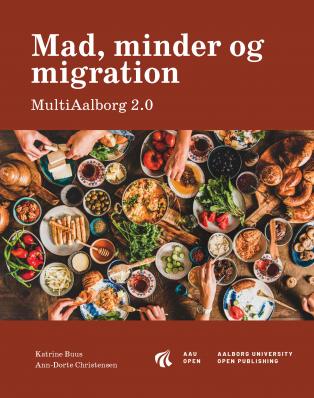
Mad, minder og migration: MultiAalborg 2.0
-

This work is licensed under a Creative Commons Attribution-NonCommercial-NoDerivatives 4.0 International License.
-

Contributors
Keywords
Identity, Belonging, Remembrance, Migration, Food culture
Abstract
Mad minder og migration: MultiAalborg 2.0 (Food, memories, and migration: MultiAalborg 2.0) explores the importance of food and meals in creating a sense of home and belonging to a community. Food is not only about nutrition; it also engages the senses and emotions, as the tastes and aromas of dishes and spices can evoke memories that extend far beyond the meal itself. In this way, food plays an important role in preserving memories of “home” and one’s place of origin. It is also essential in the process of settling into new environments. Finally, food serves as a key medium of cultural communication, as reflected in the strong public interest in Verdensfestivalen, which has been held in Aalborg over the past four years.
This is the second book about MultiAalborg. The first, MultiAalborg – Migrantfortællinger på tværs (MultiAalborg – Migrant Storytelling Across Borders), published in 2021, highlighted the interplay between the routes people have travelled and the roots they carry with them and re-establish in new places. At the same time, the book demonstrated the unique importance of the home in preserving memories as well as in creating a sense of security in new surroundings.
In this volume, we follow the trail into the homes of eight families with ethnic minority backgrounds. We enter their kitchens - sensory spaces that evoke emotions and memories and give rise to stories. From here unfold narratives from the following eight culinary traditions: Afghan, Canadian, Colombian, Greenlandic, Chinese, Palestinian, Somali, and Ukrainian.
Printed copies of the book can be purchased in the reading room at Aalborg Stadsarkiv, Vejgard Boghandel and Aalborg Boghandel.References
Andersen, J. (2014): Rundt om bordet. Trængte måltider og moderne livsformer. Tilst: Hovedland.
Andersson, S. (1980): Matens roller. Sociologisk gastronomi. Stockholm: Almqvist & Wiksell Förlag, AB.
Bak, S. L. (red.) (2016): Oral History i Danmark.Viborg: Syddansk Universitetsforlag.
Connell, R. (1995): Masculinities. University of California Press.
Counihan, C.M. (2004): Around the Tuscan Table: Food, Family, and Gender in Twentieth Century Florence (1st ed.). Routledge. https://doi-org.zorac.aub.aau.dk/10.4324/9780203491003
Danmarks Statistik. (2025): FOLK1C: Befolkningen den 1. i kvartalet efter område, køn, alder (5‑års intervaller), herkomst og oprindelsesland. Statistikbanken. https://www.statbank.dk/
FOLK1C
D’Sylva, A., & Beagan, B. L. (2011): “‘Food Is Culture, but It’s Also Power’: The Role of Food in Ethnic and Gender Identity Construction among Goan Canadian Women”, Journal of Gender Studies,
vol. 20, no. 3, s. 279–89 https://doi.org/10.1080/09589236.2011.593326
Holten, E. (2024): Underskud – om værdien af omsorg. Politikens Forlag.
Folke, J. (2026): Verdenskøkkener i Lex på lex.dk. Hentet 11. februar 2026 fra https://lex.dk/verdensk%C3%B8kkene
Edirisingha,P. et al. (2026): “Reconfiguring Migrant Meals and Doing Family: A Practice Theory Approach”, Sociology 60(1), s. 190-209.
Gullestad, M. (1984/2002): Kitchen-table society: a case study of the family life and friendships of young working-class mothers in urban Norway, Oslo: Universitetsforlaget.
Hage, G. (2010): “Migration, Food, Memory, and Homebuilding”, i Radstone, S. & Schwarz, B. (red.) Memory Histories, Theories, Debates. Fordham University Press, s. 416-427.
Halkier, B., & Jensen, I. (2011): “Doing ‘healthier’ food in everyday life? A qualitative study of how Pakistani Danes handle nutritional communication”, Critical Public Health, 21(4), s. 471–483. https://doi.org/10.1080/09581596.2011.594873
Heiko, L., Grønhøj, A., & Bech-Larsen, T. (2025): “Surviving and Sustaining: The perceived importance of sustainable diet practices among immigrant mothers”, Appetite, 208, Article 107929. https://doi.org/10.1016/j.appet.2025.107929
Hercules, O. (2022): Mamusia. Opskrifter fra Ukraine og omegn, Turbine.
Højlund, S. (2016): Smag, Tænkepauser – viden til hverdagen (40), Aarhus Universitetsforlag.
Jensen, B., Özkaya, B., & Christensen, A.-D. (2021): MultiAalborg - migrantfortællinger på tværs. Aalborg Stadsarkiv.
Kublitz, A. (2011): The Mutable Conflict: A Study of How the Palestinian-Israeli Conflict Is Actualized among Palestinians in Denmark, Museum Tuscalanum, Københavns Universitet, PhD serie no. 64.
Madkulturen (2025): Madkultur25: Madkulturens årlige befolkningsundersøgelse af mad- og måltidsvaner i Danmark. Madkulturen.
Niyomwungere, A.(2024): Smagen og duften af mit Afrika. En kogebog om Afrikas mangfoldighed og fællesskab. København: Mussmann Forlag.
Ottolenghi Y. & Belfrage, I. (2020): Smag, Lindhardt og Ringhof.
Pink, S. (2015): Doing sensory ethnography, 2nd edition, Sage Publications.
Polanyi, M. (1966/2012): Den tavse dimension. Forlaget Mindspace.
Prieur, A. (2004): Balancekunstnere. Betydningen av innvandrerbakgrunn i Norge. Oslo: Pax Forlag A/S.
Riessman, C.K. (2008): Narrative Methods for the Human Sciences. Los Angeles: Sage.
Rytter, M., Ismail, A. M., & Sparre, S. L. (2021): “Food as care and friction in late life: marginalization of Muslim immigrant families in the Danish welfare state”, Food, Culture & Society, 26(2), s. 370–386. https://doi.org/10.1080/15528014.2021.1963925Simmel, G. (1997 [1910]): “The sociology of the meal”, I Frisby, D. & Featherstone, M. (red.) Simmel on Culture: Selected Writings. London: Sage, s. 130–136.
Tamimi, S. & Wigley, T. (2020): Falastin – en kogebog, Lindhardt og Ringhof.
Thomsen, T. L., Bo, I. G., & Christensen, A.-D. (2016): ”Narrativ Forskning: Tilgange og Metoder”, i Bo, I. G. m.fl. (red.), Narrativ Forskning: Tilgange og Metoder, Hans Reitzels Forlag, s. 13-35.
Vasváris, L. (2015): “En-gendering Memory through Holocaust Alimentary Life Writing”, CLCWeb: Comparative Literature and Culture (17)3.
Von Sperling R. et al. (red.) (2015): Syriens gryder. En kulinarisk dannelsesrejse, Dansk Flygtningehjælp, Politikens Forlag.
Yuval-Davis, N. (1997): Gender and Nation, Sage Publications.
Author Biographies
Katrine Buus teaches sociology at the Department of Politics & Society, Aalborg University. Her research and teaching are grounded in the social dynamics of everyday life and in the ways people create meaning, identity, and change through daily routines and narratives. She has worked extensively with qualitative research methods, with a particular emphasis on narratives, emotions, and sensory experiences as pathways to understanding people’s lives and social change.
Ann-Dorte Christensen is Professor Emerita of Sociology at the Department of Politics and Society, Aalborg University. She has primarily worked with gender, ethnicity, and everyday life, and over a number of years has used life stories as an approach to understanding societal development.