
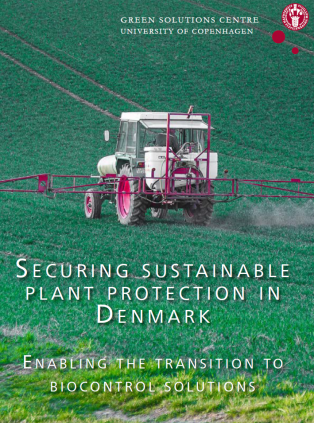
Securing sustainable plant protection in Denmark: Enabling the transition to biocontrol solutions
-

Dette værk er udgivet under licensen Creative Commons Kreditering–IkkeKommerciel (CC BY-NC).
-

Bidragsydere
Nøgleord
Biosolutions, Plant protection, Biopesticides, Potatoes, Potato blight
Resumé
Danish agriculture is entering a period of structural transitions. Regulatory withdrawals of plant protection products, including the 2025 ban on PFAS-containing pesticides, combined with increasing environmental and societal pressures, are narrowing the range of available crop protection tools. While reducing reliance on synthetic pesticides is a necessary objective, viable and scalable alternatives must be available to safeguard Danish agricultural productivity and competitiveness.
Biocontrol solutions - including microbial agents and plant-derived compounds - represent a promising but underutilised component for more sustainable plant protection. Globally expanding yet limited in Denmark, their uptake is constrained not primarily by farmer resistance, but by systemic barriers in regulation, knowledge infrastructure, market conditions, and innovation incentives.
Based on interdisciplinary research conducted through the BioPlantPro project (2025–2026), this white paper identifies three strategic policy priorities:
- Regulation & Incentives: Ensure a clear and operational EU definition of biocontrol agents and align regulatory, financial, and user incentives to actively promote environmentally friendly solutions over conventional chemical pesticides.
- Knowledge, Acceptance & Capacity:Establisha coordinated national knowledge function that integrates scientific, regulatory, and practical expertise, strengthens advisory capacity, and supports region-specific learning and implementation.
- Research & Innovation System: Implement long-term, mission-oriented funding instruments that bridge early-stage discovery with field validation, regulatory readiness, and market deployment.
By aligning regulatory reform, knowledge infrastructure, and innovation policy, Denmark can position itself as a leader in enabling a managed and economically viable transition toward sustainable plant protection.
Referencer
Danish Environmental Protection Agency. “Miljøstyrelsen forbyder 23 pesticidmidler.” 7 July 2025. https://mst.dk/nyheder/2025/juli/miljoestyrelsen-forbyder-23-pesticidmidler
European Commission. “Simpler food and feed safety rules while upholding high health standards and boosting competitiveness of EU producers.” 16 December 2025. https://ec.europa.eu/commission/presscorner/detail/en/ip_25_3081. Proposal (...) as regards the simplification and strengthening of food and feedsafety requirements: https://eur-lex.europa.eu/legal-content/DA/ALL/?uri=CELEX:52025PC1030
Eurostat. “Sales of pesticides in the EU down another 9% in 2023.” 13 May 2025. https://ec.europa.eu/eurostat/web/products-eurostat-news/w/ddn-20250513-1. https://doi.org/10.3998/mpub.12140242.cmp.9
FAO. “Pest and Pesticide Management.” https://www.fao.org/pest-and-pesticide-management/about/understanding-the-context/en/
Marrone, P.G. (2024), Status of the biopesticide market and prospects for new bioherbicides. Pest Manag Sci, 80: 81-86. https://doi.org/10.1002/ps.7403
Forfatterbiografier
Professor, Department of Plant and Environmental Sciences
Associate Professor, Faculty of Law
Research Assistant, Department of Anthropology
Associate Professor, Department of Anthropology
Postdoc, Department of Plant and Environmental Sciences