Proceedings of the 7th Conference of AG Animation 2024 (CAGA)
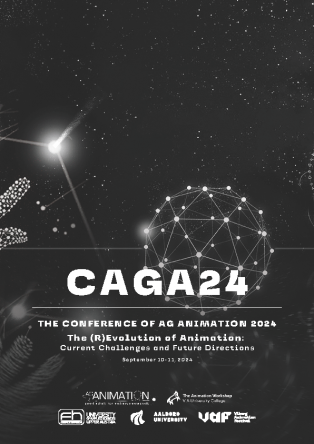
Forside af CAGA24
Redaktører

Bue Holmsgaard Fyhn (red), VIA University College, Denmark
Juergen Hagler (red), University of Applied Sciences Upper Austria, Austria, https://orcid.org/0000-0003-3440-7768
Lana Tankosa Nikolic (red), VIA University College, Denmark
Andrea Polywka (red), Philipps-Universität Marburg, Germany
Jakob Borrits Skov Sabra (red), VIA University College, Denmark, https://orcid.org/0000-0002-3665-2380
Peter Vistisen (red), Aalborg University, Denmark, https://orcid.org/0000-0002-9194-2946

Nøgleord

AG Animation, CAGA24, AI, Virtual production, Ethics, Transformation

Synopsis

Welcome to the Proceedings of the 7th Conference of AG Animation 2024 (CAGA), hosted by The Animation Workshop, VIA University College in Viborg from September 10th to 11th, 2024. CAGA 2024 served as a nexus for scholarly discourse, professional exchange, and creative exploration, uniting academics, industry practitioners, curators, and enthusiasts within animation & the visual arts. The conference was dedicated to rigorously examining the rapid advancements, emergent trends, and substantive research that are collectively reshaping the field of animation and visual storytelling. The conference theme, “The (R)Evolution of Animation: Current Challenges and Future Directions”, was chosen to reflect the dynamic state of contemporary animation – a field undergoing not merely incremental change but a fundamental transformation. This evolution is driven by technological innovation yet simultaneously challenged by complex ecological, political, ethical, and industrial forces. The conference sought to identify and analyze the catalysts for this growth while confronting the significant impediments currently facing the field. This volume compiles the output generated during these focused discussions, providing valuable perspectives on the current state and prospective trajectories of animation art, practice, scholarship, and industry.

The conference was anchored by four thought-provoking keynote addresses that illuminated the technological and artistic currents reshaping animation today. Bonnie Mitchell opened the programme by demonstrating her stewardship of digital heritage, drawing on her decades-long quest to preserve and contextualise the SIGGRAPH media archives – capturing the fluidity of the digital material over time. Photomedia artist Boris Eldagsen followed with a candid account of his headline-making “Electrician” intervention, framing generative AI not as a threat but as an extension of the photographer’s craft that still demands rigorous concept and composition. Shifting from images to moving sets, Henrik Schønau Fog showcased Aalborg University’s rear-projection Virtual Production Training Facility, illustrating how real-time game-engine pipelines are lowering barriers for filmmakers, animators, and students to experiment with volumetric worlds. Finally, directing duo Michelle and Uri Kranot unpacked the collaborative research methods behind their award-winning immersive works, arguing that expanded animation’s capacity for embodied, participatory viewing can revivify animation’s core when fused with meticulous hand-crafted aesthetics. Together, the keynotes charted a continuum from preservation to provocation, from technical infrastructure to experiential artistry, and set the thematic stage for the contributions that follow.

Within these pages, the breadth of contemporary animation research is on full display. A significant portion addresses the profound impact of technological shifts, particularly the increasing integration of advanced computational tools and real-time technologies. The paper Real-Time Animation, AI and Virtual Production: Opportunities and Challenges directly engages with this intersection, exploring the potential of real-time animation and AI to enhance virtual production workflows, while also considering the practicalities of establishing accessible training facilities. Expanding on the pedagogical dimension of these technologies, Teaching Virtual Production in Higher Education investigates the challenges of skills transfer in virtual production, drawing upon insights from the Virtual Production Studio Network (VPSN) research project and advocating for cost-effective educational strategies to bridge the existing knowledge gap. Artificial intelligence emerges as a particularly transformative, and at times contentious, area of focus. Its application is shown to extend beyond contemporary production into the critical analysis of historical materials. AniVision: New Technology-Assisted Approach to Studying Animation History presents an innovative methodology utilizing machine learning and computer vision to systematically analyze large corpora of ephemeral films, thereby facilitating the discovery and study of previously overlooked animation practices embedded within these historical documents. Further exploration into the intersection of AI and archives is provided by Brosch AI - Distorted Dreams: Expanding and Animating an Archive With AI. This project demonstrates the use of AI, including style transfer, to expand and animate archival artistic works, prompting essential discussions on the preservation of artistic integrity, the definition of authenticity, and the inherent technical and ethical complexities, including intellectual property and potential distortions, raised by such applications. The broader ethical landscape of AI-driven creativity is also considered, with themes aligning with discussions captured in contributions exploring AI image generation examples and ethical context, highlighting ongoing debates around copyright, algorithmic bias, and the responsible deployment of AI in creative processes.

The expanding horizons of animation also encompass its integration into immersive environments. A Pathway to Immersive Storytelling: From Linear to Participatory charts the evolution towards more interactive and participatory narratives within extended reality formats like VR and AR, moving beyond traditional sequential structures.
A critical challenge within these new spatial computing contexts is the effective guidance of audience attention without breaking immersion or limiting user agency. This challenge is specifically examined in Guiding Attention in Virtual Reality Theater - A case study of the VR Performance Symmetry, which draws on a VR theater production to analyze techniques for directing viewer focus in immersive experiences. As the field embraces these new forms, the importance of preserving earlier digital forms is also recognized. The paper on the Preservation of Web-Animation in a Post-Flash Era contributes valuable research into the methods and archival efforts dedicated to safeguarding web-based animation, particularly those created with technologies like Flash, acknowledging its historical significance and the complex relationship between legacy and emerging media platforms.

Beyond technological advancements, the conference proceedings address critical industrial, societal, and cultural dimensions of animation’s evolution. The human capital within the industry, specifically leadership models and workplace dynamics, is explored in Leading the Future: Exploring Transformational Leadership in the European Animation, Games, and VFX Industries. This research identifies a crucial industry shift away from traditional ‘crunch’ cultures towards more sustainable and supportive environments, emphasizing the increasing value placedon emotional intelligence, mentorship, and shared team ownership in effective leadership within creative sectors. Complementing this internal focus, the papers also highlight the industry’s growing responsibility towards environmental and social sustainability. The paper, From Carbon Footprint to Social Justice further underscores the urgent necessity for clear guidelines and dedicated research into sustainable production practices, detailing the significant environmental footprint of traditional production methods and advocating for robust social guidelines addressing labor rights, mental health, and diversity.

Perspectives from diverse global contexts reveal unique adaptive strategies and challenges. Insightful analyses of the South African animation industry are given in South African Hacked Animation Methodologies and South African Animation: Decolonial Framework and IP Control, which illustrate how local animators strategically employ innovative, often ’hacked,’ production methods to navigate significant economic, political, and infrastructural limitations. These approaches frequently leverage internet-based distribution and prioritize the retention of intellectual property as a means of fostering sustainable practices and asserting creative autonomy. Crucially, these contributions argue for a re-evaluation and decolonization of the academic discourse surrounding South African animation, urging the adoption of analytical frameworks that acknowledge and value these localized adaptive practices over restrictive, externally imposed notions of “authentic” African animation. Finally, the capacity of animation to serve as a tool for critical social commentary and speculative future-casting. Black Pudding: A Speculative Visual Index undertakes a transgressive methodology utilizing AI-porn content generators to investigate the potential and limitations of generative AI in creative pornography production. The paper extends the discussion of AI-generated pornography beyond the prevalent focus on deep fakes, raising crucial ethical concerns regarding the use of such tools for creative research, and suggests a need to ‘hack’ the metaphor of “unlimited” AI content generation by revealing its representational constraints and proposes that moderation strategies from existing non-live-action media platforms could inform more effective governance of AI-generated content. Finally, the work On-Screen Prototypes: Making Speculative Designs for and Through Animation illustrates how techniques derived from speculative designand design fiction can utilize animated prototypes to critically examine the potential impacts of media technologies and stimulate important discussions about plausible future realities.

Looking across these diverse contributions, a powerful narrative emerges. The challenges discussed, spanning technological disruption, ethical quandaries, environmental responsibility, organizational culture, and systemic inequalities, are not merely impediments but rather potent drivers for innovation and critical engagement within the field. The research contained within this volume collectively demonstrates a community of practitioners and scholars characterized by adaptability, critical reflexivity, and a clear orientation towards shaping the future. From pioneering accessible virtual production methods and employing AI for historical analysis, to advocating for sustainable practices, decolonizing creative discourse, and exploring new narrative forms in immersive media, the work presented here exemplifies a field actively engaged in its own transformation.

The “(R)Evolution” of animation is undeniably underway, characterized by both revolutionary technological leaps that redefine production possibilities and a necessary, evolving critical awareness of its broader social, ethical, and environmental responsibilities. The papers compiled in these proceedings offer not only a valuable snapshot of this complex moment but also provide foundational research and strategic insights crucial for navigating the path forward. As we absorb the diverse findings and consider the implications of these contributions, we are equipped to view the future of animation not with uncertainty, but with a grounded optimism for its continued capacity for creative, technological, and societal impact. The challenges ahead are substantial, but the intellectual rigor and innovative spirit reflected in these pages suggest a field well-positioned to meet them, fostering a future for animation that is both technologically advanced and deeply engaged with the complexities of the world it reflects and shapes.

We hope you will enjoy and engage with the contributions in these proceedings!

Citation/Eksport

Holmsgaard Fyhn, B., Hagler, J., Tankosa Nikolic, L., Polywka, A., Borrits Skov Sabra, J., & Vistisen, P. (Eds.). (2025). Proceedings of the 7th Conference of AG Animation 2024 (CAGA). Aalborg University Open Publishing. https://doi.org/10.54337/caga24