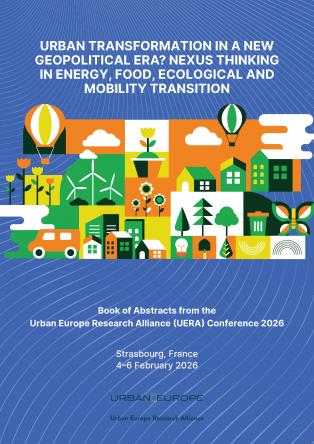
Book of Abstracts from the Urban Europe Research Alliance (UERA) Conference 2026
-

This work is licensed under a Creative Commons Attribution 4.0 International License.
-

Editors
Keywords
Urban Europe Research Alliance, UERA, Urban transformation, Nexus thinking, Interdisciplinary Research
Abstract
The 2026 conference marks a milestone in the Urban Europe Research Alliance (UERA), building on the Karlsruhe (2024) and Rome (2025) conferences. It brings together a diverse academic community working on urban transformations under conditions of rapid social, environmental, and technological change. This Book of Abstracts reflects the breadth and vitality of the contributions, as well as UERA’s role as a long-term platform for academic exchange across disciplines and contexts.
The conference supports UERA’s broader ambition to foster continuity and cumulative learning beyond individual research projects. In contrast to funding-bound research structures, UERA provides a durable infrastructure for developing and revisiting concepts, methods, and debates over time.
The 2026 thematic focus highlights nexus thinking across energy, food, mobility, and ecological transitions. The conference invites contributions exploring interdependencies and governance challenges in complex urban transformations.
The contributions illustrate the diversity of approaches within the UERA community and should be read both as a snapshot of current research and part of an ongoing collective dialogue.
For more information, visit the conference website.Author Biographies
Enza Lissandrello is an Associate Professor at Aalborg University with a background in urban planning and public policy, human geography and socio-technical transition studies. Her work examines urban and regional planning under contemporary trends of reflexive modernization, participation, deliberation, conflicts and issues of representation. She has taught and published on the roles of the planners and policy actors in planning with sustainable aims and though deliberative forms. She has led various empirical projects on cross-border governance in Italy, France and Switzerland (the Mont-Blanc area), the planning of sustainable transitions in The Netherlands (Amsterdam and Waterdunen) and on the role of planners as catalysts of change in Scandinavian countries (Denmark, Norway and Sweden). She has also engaged in research on gamification as a mediation strategy between citizens and policy managers in several EU cities (Amsterdam, Ghent, Helsinki, Fundao, Palermo, Barcelona) for the transformation of urban mobility values. Her main research interests are on the practice and the theory of planning, urban governance and participation, deliberation and power, performative studies, sustainable transitions, interpretive methods of policy analysis and planning, critical approaches to smart citizenships.
Aude Dziebowski is a PhD student in sociology within the research team “Territorial Dynamics: Population, City, Nature” of the CNRS / University of Strasbourg joint research unit “Societies, Actors and Government in Europe” (SAGE, UMR 7363), France. She teaches at the Institute for Urbanism and Regional Development of the Faculty of Social Sciences in Strasbourg. Her main research fields deal with rural sociology and sociology of the environment, especially society-nature relations, socio-ecological change, agricultural and energy transition.